A fogged window is a failed seal, and a clear one proves less than you think
On inspections in California homes with older aluminum or vinyl windows, fogged glass is one of the findings we see most, and it is also one of the most misread.
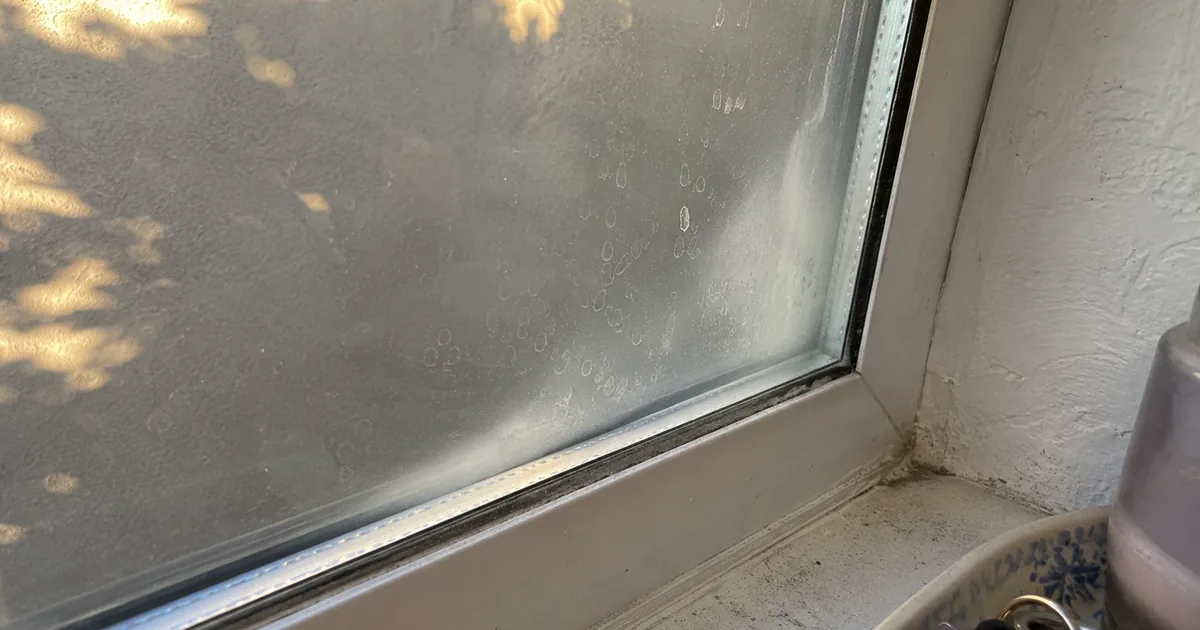
If haze, droplets, or a milky film sits between the glass layers and cannot be wiped away, the sealed insulated glass unit has usually lost its seal. Moisture has entered the space between the panes. The window may still open, close, latch, and keep rain outside. That does not make the glass unit healthy.
The reverse mistake is just as common. A window can look perfectly clear during the inspection and still have a failed seal. Fog comes and goes. Temperature, indoor humidity, outdoor conditions, and sun angle all affect what you see.
That creates a narrow but real inspection limit. We report visible conditions. We do not test a window seal in a laboratory. The InterNACHI Residential Standards of Practice require reporting an “obviously fogged” window or other evidence of a broken seal, while also stating that the inspector is not required to determine the integrity of multiple-pane glazing or thermal window seals.
The practical question is not whether every clear window has a perfect seal. You cannot prove that from a visual inspection. The useful question is what the visible finding means, what else is wrong with the window, and whether the sealed glass unit can be replaced without replacing the entire window. Our overview of what a home inspection covers and what needs a specialist draws the same line for the rest of the house.
What is actually inside a double-pane window
A double-pane window is not simply two pieces of glass placed next to each other. It is an insulating glass unit, often called an IGU, with the panes sealed together around their edges.
The space between the panes is typically filled with an inert gas such as argon or krypton. The panes must stay at a controlled distance from each other. Along the perimeter, the edge seal holds that spacing and blocks water vapor from entering while limiting the loss of the gas fill.
The edge seal has three basic parts: a spacer bar, a desiccant, and a sealant.
The desiccant is there to absorb small amounts of moisture inside the sealed space. It is not an unlimited moisture sponge. Once it becomes saturated, it cannot keep removing incoming moisture.
Many IGUs use two sealants. The primary sealant is typically polyisobutylene, also called PIB, applied between the spacer bar and the glass. Its job is to reduce water vapor and gas permeability. A secondary sealant, often polyurethane, silicone, or polysulphide, is applied around the perimeter.
That second seal matters. The Lawrence Berkeley National Laboratory report LBNL-6122E, a 2013 review of window spacers and edge seals, explains that PIB becomes less strong as temperature rises, so a PIB seal alone cannot provide the needed structural integrity. A secondary sealant is required.
The total edge seal width is typically 8 to 12 millimeters. That narrow strip around the glass is doing several jobs at once. It holds the panes apart. It limits vapor entry. It helps retain the gas fill. It also has to tolerate repeated temperature changes, movement, and exposure at the window edge.
How the seal fails and why you see fog
The usual failure sequence is simple. The edge seal begins allowing moist air into the space between the panes. The desiccant absorbs that moisture for a while. Eventually, the desiccant can become saturated. Moisture then condenses on the inside surfaces of the glass, where you cannot wipe it away from either side.
The details vary by window design, age, exposure, and the condition of the seal. We cannot determine the exact failure point from a fogged appearance alone.
The LBNL report describes a specific weakness in the sealing materials. PIB adhesion to glass and the spacer is not resistant to continuous water exposure. The report also states that when butyl sealant becomes damp, it loses its ability to adhere, which can lead to premature failure of the insulating glass unit.
That does not mean every fogged window failed for one identifiable reason. Water exposure may be part of the story. Heat, movement, manufacturing problems, installation conditions, and the age of the unit may also matter. A field inspection usually identifies the condition, not the complete history of the seal.
The visible result is often a soft haze at the edges, droplets inside the unit, mineral-looking streaks, or a cloudy film across part of the glass. Sometimes the glass is only cloudy in the morning. Sometimes it clears after the sun reaches the window. Sometimes it appears worse on a cool day.
This is why a failed IGU can remain functional in several other ways. The frame may be sound. The sash may operate normally. The window may still provide weather protection. The sealed glass unit can still be failed even when the rest of the assembly looks ordinary.
Fog, dew and condensation are not the same thing
Three conditions can look similar from across a room, but they have different meanings.
Fog or droplets on the room-side surface usually point to indoor humidity. You can wipe that moisture from the exposed interior face of the glass.
Condensation on the outdoor-facing surface is usually dew or outside moisture. It sits on the exposed exterior face and can also be wiped away.
Haze, droplets, mineral-looking streaks, or a milky film between the panes point to a failed seal when the condition cannot be wiped from either exposed surface.
The field check is basic. Wipe the room-side glass. Then check the outdoor-facing glass if it is safely accessible. If the haze stays in the same place, the moisture or film is likely inside the sealed unit.
The word “likely” matters. We identify what the glass shows. We do not cut the unit apart during a home inspection. A glazing contractor or the window manufacturer can confirm the unit design and replacement options.
Look closely at the edge of the glass. A small patch of haze may be easy to miss from the doorway. A large clouded area may be obvious from the street. Mineral-looking marks can also be mistaken for dirt, especially on older windows with worn screens or dusty tracks.
A cloth cannot fix an internal seal failure. It can remove surface moisture and dirt. It cannot wipe the inside of a sealed IGU.
What the InterNACHI standard asks an inspector to report
The InterNACHI Residential Standards of Practice state that the inspector shall report any window that was “obviously fogged or displayed other evidence of broken seals.”
That is the reporting requirement tied to the visible condition. If the window is obviously fogged during the inspection, it belongs in the report.
The same standard says the inspector shall inspect a representative number of doors and windows by opening and closing them. That means the inspector does not operate every window in the house. A window can be present, clear, and unoperated because it was outside the representative sample or could not be safely accessed.
The exterior section of the standard also says the inspector is not required to determine the integrity of multiple-pane window glazing or thermal window seals.
Those provisions work together. We look for visible fogging and other evidence of a broken seal. We report what we can observe. We do not certify every invisible seal as good.
The report should also distinguish between a fogged glass unit and a window that has a separate operating or structural problem. A window that does not latch, a cracked pane, a leaking frame, or a rotted sill is not the same finding as internal condensation between panes. Our guide to reading a home inspection report in California explains how to tell those apart on the page.
At Inspection.re, we document the location and visible condition. The person reading the report should be able to tell which room contains the fogged window, whether the condition was visible from the accessible side, and whether other window problems were observed.
Why a clear window can still have a failed seal
A clear window is only clear at the time you look at it.
The amount of moisture visible between panes changes with temperature, humidity, and sun angle. A window that looks cloudy early in the morning may clear after the glass warms. A window that looks clear during a bright afternoon may show moisture later under different conditions.
That is why the InterNACHI wording uses “obviously fogged.” The inspector reports a condition that is visible at the inspection time. The wording does not require the inspector to prove that every window seal is intact.
A clear-looking window on inspection day is not proof of a good seal. It is evidence that no obvious fogging was visible at that time.
This is also why a report may identify some fogged windows without claiming that every other window is sound. A failed unit can be intermittent in appearance. Other units may have early seal deterioration that does not produce visible haze during the inspection.
The limitation is not a reason to ignore a clear window. It is a reason to describe the finding accurately. If the glass is clear, report it as clear. If the seal cannot be tested as part of the inspection, do not turn that clear appearance into a guarantee. The same honesty applies to areas an inspection could not reach, which a good report states rather than skips.
The same caution applies when someone says, “It was fogged yesterday.” That history may matter, but it is not the same as visible evidence during the inspection. A glazing contractor can evaluate the unit more directly and identify whether the glass assembly is replaceable.
What a fogged window does and does not mean
A fogged window is usually a performance, appearance, and cost issue. By itself, it is not usually a safety hazard, a mold finding, or a structural problem.
The loss of the sealed space can affect the window’s insulating performance and appearance. The practical effect depends on the unit, the location, the amount of fogging, and the condition of the surrounding frame.
A fogged IGU is also not automatically a material defect under the InterNACHI definition. Section 1.2 describes a material defect as a specific issue with a system or component that may have a significant adverse impact on the property value or that poses an unreasonable risk to people. The same section says that being near, at, or beyond the end of normal useful life is not, by itself, a material defect.
That does not make the finding meaningless. It means the wording should match the condition. A fogged window is usually described as a failed sealed glass unit with a performance and appearance consequence. The report should not call it a life-safety emergency without another observed condition supporting that conclusion.
Other window findings can matter more. A cracked pane may create a separate concern. A window that does not latch has an operating problem. A leaking frame can affect adjacent materials. A rotted sill can indicate damage beyond the glass unit. An inoperable bedroom window may also raise a different question about its operating condition.
For a person weighing a repair request, a fogged window is a legitimate line item. It is usually modest compared with roof, electrical, or plumbing findings, and it is usually not what decides a deal by itself. The number of affected units and the condition of the frames matter more than the word “fogged” alone. The mechanics of that conversation are in our guide to the California inspection contingency.
How to decide what to do with the finding
Start with the count. How many sealed glass units show internal haze or droplets? Are they clustered in one room, spread through the house, or located in the same window line?
Several failed units in the same line may suggest a product or installation issue. That is an honest possibility, not a conclusion from appearance alone. A contractor or manufacturer should confirm it.
Next, inspect the frames. If the frame, sash, sill, or surrounding materials are failing, replacing only the glass may be a poor spend. If the frame is sound and the problem is limited to the sealed unit, glass replacement may be practical.
Then look at the home’s age mix. Are the windows original while other windows were replaced later? Are there several window styles and manufacturers? A house with mixed window ages can have several different replacement decisions hiding under one report comment.
Location changes the priority. A fogged picture window may mainly affect the view and appearance. A bathroom window may be exposed to different humidity conditions. A bedroom window requires attention to its operating condition as a separate matter. We do not turn a fogged seal into a code conclusion, but we do check whether the window operates when that is within the inspection scope.
Get a glazing contractor or the window maker to confirm whether the sealed glass unit can be replaced separately. Some assemblies are designed for glass-only replacement. Others may make whole-window replacement more practical because of age, condition, availability, or frame problems. Our note on which contractor license applies to a referral covers who to call.
Finally, check the warranty before paying for work. Warranty terms vary by manufacturer. They generally exclude labor, so the actual coverage depends on the specific window and the written terms that apply to it.
The inspection report should give the contractor a useful starting point. Location and count are the details that make a quote possible. “Some windows are fogged” is less useful than a room-by-room list with photographs and comments.
Warranty, replacement and permits need separate checks
The usual repair is replacement of the sealed glass unit, not replacement of the entire window. That is only a starting point.
The window maker, product line, frame condition, and age determine whether a glass-only repair is practical. A contractor may need the manufacturer name, a product label, measurements, or photographs of the edge and frame. Do not assume that a visually similar pane is the correct replacement.
Warranty terms also vary. Check the specific manufacturer’s written warranty before authorizing work. Coverage may apply to the glass unit but not to labor, removal, access, trim, or installation. The warranty question belongs with the manufacturer or contractor, not with a general inspection assumption.
Replacement windows and permits have their own California rules. Our article on SB 908 and window replacement permits covers that separate issue. The inspection finding does not answer the permit question.
A homeowner preparing to list may benefit from finding the problem first. A contractor can inspect the affected units, confirm whether glass-only replacement is available, and provide a quote before the condition appears in someone else’s report. We make the wider case in is a pre-listing inspection worth it.
After any repair, confirm the work rather than trusting the invoice. We cover that in how to verify repairs before close of escrow.
How we document a fogged window in an Inspection.re report
At Inspection.re, we photograph the fogged window, tag the finding in the Matterport 3D tour at its location, and describe it in plain English in the same-day report.
The report identifies what was visible. It does not claim that every clear window has a verified seal. Where appropriate, we note that other windows may have failed seals that were not visible under the conditions present that day.
That distinction gives the person who commissioned the inspection a usable next step. The contractor can find the window. The agent can understand the scope. The homeowner can decide whether the issue is worth pursuing now or bundling with other window work.
Use the report to decide what happens next
We provide same-day reports with photos and InterNACHI-certified inspectors for service in Temecula, Murrieta, Riverside, San Diego, and Los Angeles.
See what an inspection includes before scheduling, look at a sample inspection report to see how findings are tagged and described, and use the FAQ when a term is unclear.
A fogged double-pane window usually means the insulated glass unit seal has failed. Wipe the exposed glass surfaces, count the affected units, check the frame and operation, then ask a glazing contractor or the window maker whether the sealed unit can be replaced separately. Check the warranty before paying, and review the California permit rules separately for any replacement work. A clear window is only a clear window on that day.
For an inspection question, call 1-888-88-INSP-9.