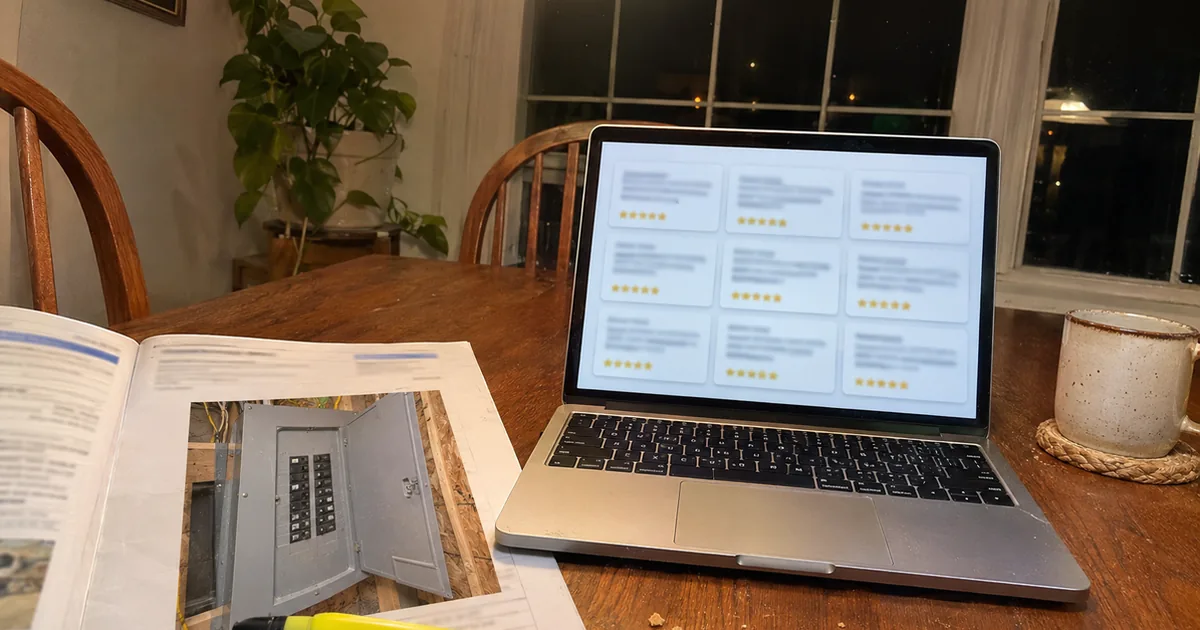
We get asked how to choose between inspection companies on stars alone. A score is an average of feelings about an appointment. The inspector arrived on time. The report came quickly. The buyer felt listened to.
Those facts matter. They are not the whole inspection.
This guide covers how to read the written reviews for what they can show you, what they cannot show you, what the law says about fake reviews, and how to test a company with a sample report, its Standards of Practice, and a few questions that a review cannot answer.
A review can show you how the appointment felt
A review can show you how the company communicated, whether the inspector arrived when promised, how well the findings were explained, how quickly the report arrived, and whether the reviewer felt pressured.
Those are things the customer actually experienced. They are useful.
Look for details such as:
- The inspector explained the electrical panel.
- The inspector walked the buyers through the attic.
- The report arrived the same day.
- The questions were answered without rushing.
A review that names something the customer saw is more informative than five stars with no text. “Great inspector” tells you almost nothing. A review that says the inspector stopped at the furnace and explained why the venting needed attention tells you how the appointment worked.
We see reviewers praise a “thorough” report because it was long. Length is not the same as judgment. A report can run many pages and still fail to rank what mattered most to the buyer.
Those details help you judge the service around the inspection. They do not prove the inspection itself was complete.
A review cannot show you what the inspector missed
A review cannot tell you whether the inspection missed something the buyer was never told about.
Most reviews are written within days of the appointment. That is before the first rainy season, the first summer on the air conditioner, or the first winter on the furnace. If a missed finding appears later, it rarely makes its way back into the original review.
A buyer also cannot know whether a crawlspace was fully entered unless the report or the inspector says so clearly. The buyer may see a crawlspace photo and still not know whether part of the area stayed out of reach.
Any inspection has limits. Inspectors cannot see inside walls. The inspection is visual and noninvasive. A review cannot turn a visual inspection into a guarantee about concealed conditions. What a general inspection leaves to specialists is laid out in what a home inspection covers and what needs a specialist.
A reviewer may also mistake a long report for a thorough one. A report filled with generic photos can look substantial. A report that lists every minor defect can feel detailed while giving too little attention to drainage, roof conditions, electrical hazards, or heating equipment.
Read the review for the appointment. Read the report for the work. If you want to know what a good report should do with its findings, start with how to read a home inspection report in California.
The reviewer’s job changes what the review means
Ask who wrote the review: the buyer, the seller, or an agent.
A buyer experienced the findings and the appointment. An agent experienced the deal. An agent may value an inspector who communicates clearly, delivers on time, and keeps escrow moving.
That is not an accusation. It is a question about which job the reviewer was judging.
California Business and Professions Code section 7197 addresses an inspection engagement where employment or payment depends on the conclusions in the report or the close of escrow. It also bars an inspector or company from paying or giving an inducement to an owner, broker, or agent for referring business. Read the current text yourself. This is a summary, not a quotation.
A glowing review from a referral source tells you the referral source is satisfied. It does not tell you what the buyer’s report said.
The buyer chooses the inspector, and an agent may suggest one. The relationship is spelled out in our guide to third-party home inspection on a California purchase.
When you read reviews, label the writer before you weigh the praise. “The agent said the inspector was easy to work with” is useful information about the transaction. It is not the same as a buyer describing a roof, attic, crawlspace, or electrical finding.
Three-star reviews show where the service strains
The middle reviews often contain the specific complaints.
Read them for patterns. Look for scheduling delays, reports that arrived late, or an inspector who rushed through the appointment. One complaint may be a bad day. Several similar complaints deserve more weight.
Read the company’s reply too. A defensive reply, or no reply at all, tells you something about how the company handles a dispute. A reply that addresses the specific concern gives you more to evaluate.
One angry review about a deal that fell apart may reflect the deal rather than the inspector. The inspection may have uncovered a serious condition, and the buyer may have disliked the result. That is different from a pattern of missed calls, late reports, or unexplained limitations.
The question is not whether every reviewer was happy. The question is whether the same service problem appears repeatedly and how the company responds when it does.
Do not let a single glowing review cancel out a repeated complaint. Do not let one angry review decide the whole question either.
Compare what two companies’ reviews actually describe
Pick two companies and write down what each of the last ten written reviews describes. Do not write down the stars.
Make four short columns: communication, timing, explanation, and anything about the house itself. Then count where each company’s reviews cluster.
One company’s praise may sit entirely in communication and timing. The other’s may include reviewers who describe a finding, what it meant, and what they did about it. Neither pattern is proof of anything. The second tells you more about what happens during the walk-through, and that is the part you are hiring.
This takes about fifteen minutes. It is slower than comparing two decimals and a good deal more informative.
The FTC rule makes some fake review tactics unlawful
The Federal Trade Commission’s rule, 16 CFR Part 465, bans fake and bought reviews. The FTC’s Q&A says the rule went into effect on October 21, 2024.
The rule covers reviews from people who do not exist, including AI-generated fake reviewers, and reviews from people who did not have actual experience. It bars creating or selling those reviews. It also bars buying or procuring them from insiders, or distributing them when the business knew or should have known they were fake.
The rule prohibits compensation or incentives conditioned on a review expressing a particular sentiment, whether positive or negative, including a requirement that is only implied. Incentives are not banned outright. The FTC Q&A says they can be allowed when there is no express or implied requirement about the review’s sentiment.
The rule also prohibits insider reviews that fail to clearly and conspicuously disclose the reviewer’s material connection to the business. It bars a company from misrepresenting that a website or entity it controls provides independent reviews or opinions.
A business cannot use unfounded or groundless legal threats, physical threats, intimidation, or certain false public accusations to prevent or remove a negative review. It also cannot misrepresent that the reviews on a review section of its website represent all or most reviews submitted if negative reviews were suppressed based on their rating or sentiment.
The FTC says the rule lets the agency “seek civil penalties against knowing violators.”
The FTC Q&A says the rule does not contain a specific prohibition against asking only the customers a business thinks are happy for reviews. It adds that such conduct “could violate the FTC Act.”
The practical point is simple. A company’s own testimonials page is marketing, and the company chooses what to show. An independent platform is a better place to look, but the rule does not make any review page a verified record.
We are not lawyers, and this is not legal advice. If you suspect fake reviews, you can report them to the FTC.
Repeated language can signal manufactured reviews
Look for sameness.
The same phrases repeated across reviews deserve attention. A burst of reviews in a few days deserves attention too. So do reviews that praise features without naming a house type, a city, or any moment from the appointment.
A reviewer with a single review ever is another signal to weigh. It is not proof that the review is fake. It simply gives you less history to assess.
These are signals, not verdicts. Real customers can use similar words. A company can receive several reviews close together after asking recent customers to write them. A customer may leave out property details for privacy reasons.
Read several reviews together. Compare the wording, the level of detail, the timing, and the reviewer’s apparent connection to the business. Then compare those impressions with the sample report and the answers you get by phone.
A sample report exposes work that praise cannot
Ask for a sample report and the Standards of Practice before you book. The HUD FHA homebuyer flyer HUD-92564-CN, dated 02/09/2023, tells buyers to ask a prospective inspector for the Standards of Practice or a sample report and to get references.
A sample report shows photo quality, how findings are ranked, and how inspection limits are stated. It gives you something concrete to examine.
You can review a sample inspection report from Inspection.re and see what is included. Look at whether the photos identify the condition clearly. Check whether the report separates a serious defect from routine maintenance. See whether limitations are stated plainly.
Ask these three questions by phone:
- Does your fee change if the deal does not close?
- Do you perform repairs on houses you inspect?
- Can I see a sample report before I book?
The first two come from Business and Professions Code section 7197, as covered in the third-party inspection guide.
Inspection.re publishes these service details: a same-day report within 6 to 8 hours, a Matterport 3D tour with tagged findings, FLIR infrared imaging, drone roof views, a LIDAR floor plan, and inspectors who are InterNACHI certified. Those are things you can verify in a sample report or through direct questions. A review does not prove that any of them happened during your inspection. We inspect across the state, including San Francisco, Los Angeles, San Diego, and San Jose.
Use five checks before you book
Use this five-step routine:
- Read the three-star reviews first.
- Sort by newest and check the last six months.
- Note who wrote each review: buyer, seller, or agent.
- Open a sample report.
- Ask the three questions.
Then compare the answers with the inspection scope. If you need a list of conditions to raise with whoever you hire, use the California home inspection checklist.
Five questions buyers ask about inspector reviews
Is a 4.7 better than a 4.9?
No. The gap says little by itself.
A higher number from fewer reviews is weaker evidence than a slightly lower number supported by many specific reviews. Compare the content, not the decimal.
Should I trust reviews on the company’s own website?
Treat them as marketing. The company chooses what to show.
The FTC rule bars misrepresenting that a review page contains all or most reviews when negative reviews were suppressed. Read an independent platform too, then check the sample report.
Does a bad review mean I should avoid the company?
No. Look for a pattern and read the company’s reply.
One angry review about a failed deal may reflect the deal. Repeated complaints about late reports, rushed appointments, or poor communication deserve more weight.
Can my agent pick my inspector?
The buyer chooses the inspector. An agent may suggest one.
Ask who benefits from the referral and read the current text of Business and Professions Code section 7197. The buyer’s side of that choice is covered in what a pre-purchase inspection is in California.
What if there are no reviews?
New companies exist. Use the sample report and the questions instead.
Ask for the Standards of Practice, request references, and review the company’s inspection scope. You can also compare home inspection costs in California without treating price as proof of quality.
Stars measure the appointment, not the inspection
Stars measure how the appointment felt. The sample report measures the work.
Read our reviews page and apply the same tests to it. Then review what is included, read the FAQ, and open the sample inspection report before you schedule.
Use the review as one piece of evidence. Ask the three questions. Read the report before you book.
Related reading
- How to Read a Home Inspection Report in California. What a report should do with its findings.
- A Third-Party Inspector Works for Neither Side of the Deal. Who hires whom, and what section 7197 keeps separate.
- California Home Inspection Checklist, Day by Day. The questions to ask at each stop.
- How Much Does a Home Inspection Cost in California. What drives the price.
- What a Home Inspection Covers, and What Needs a Specialist. The limits of a general inspection.