Galvanic Corrosion at Dissimilar Metal Pipe Joints: A Hermosa Beach Agent’s Guide
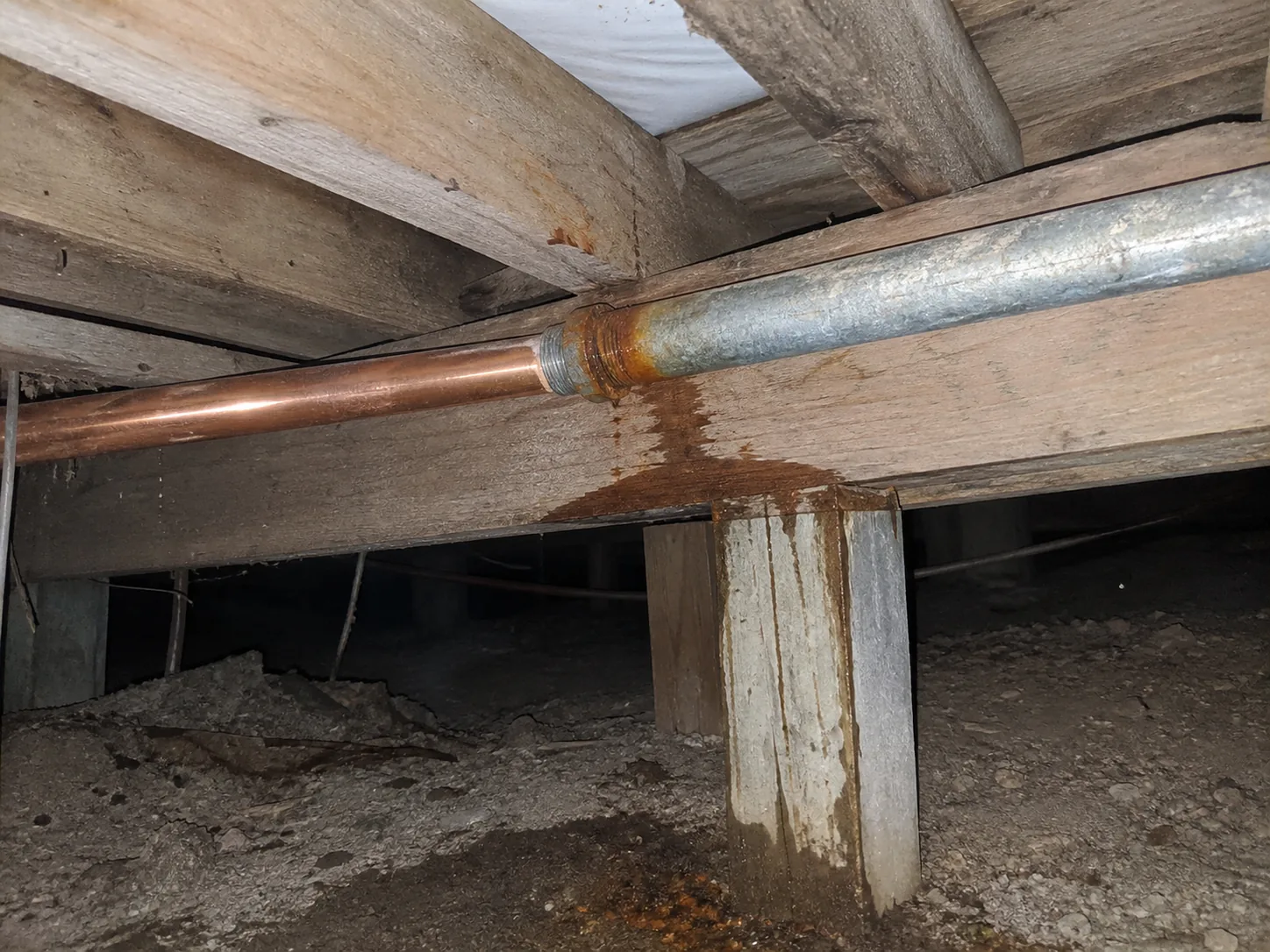
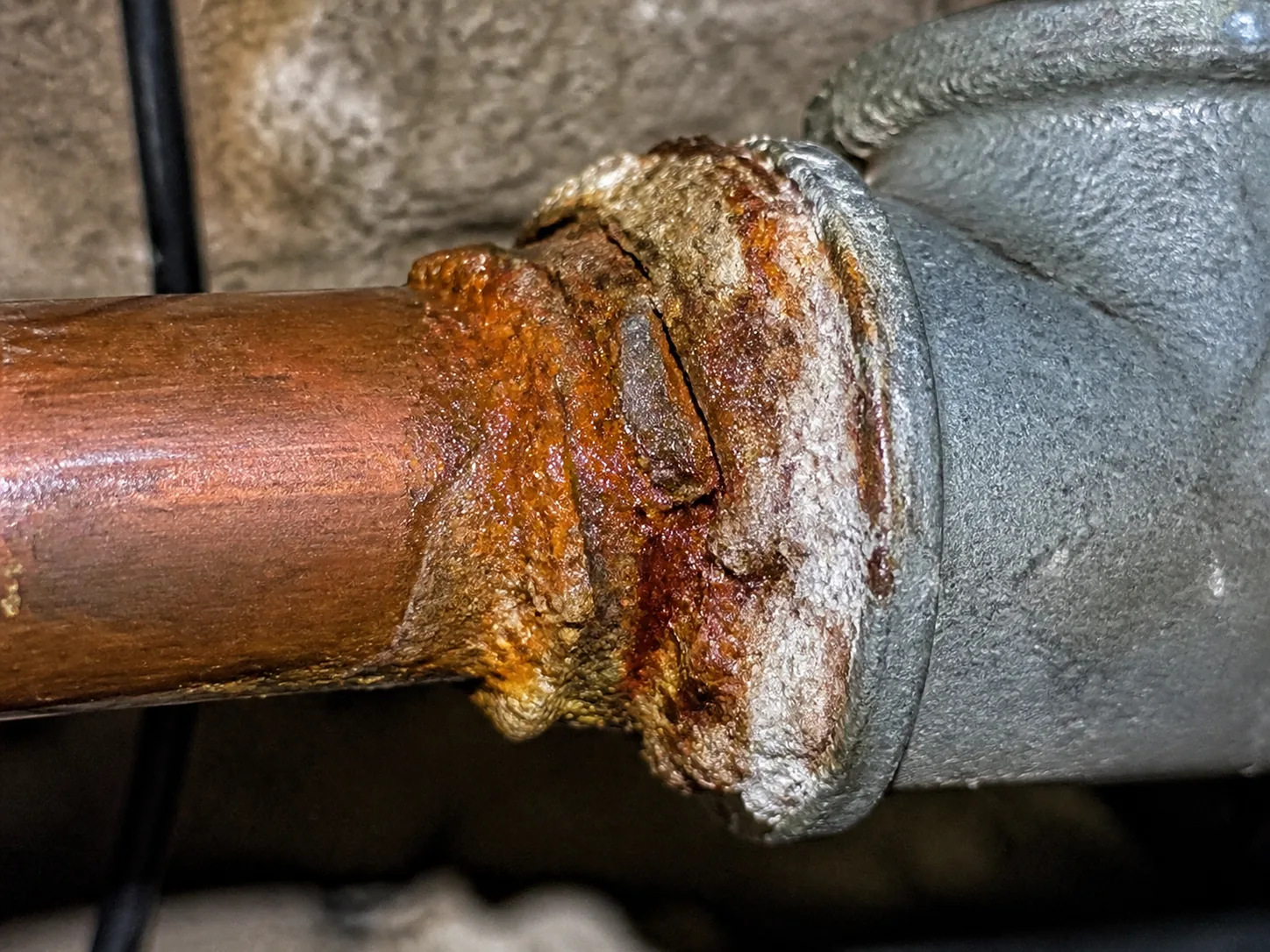
A buyer’s agent walking a 1940s beach cottage a few blocks off the Strand asked why the seller’s disclosure said the house had been repiped in copper while the inspector’s report kept using the word galvanized. Both were true. The accessible runs under the house and through the garage had been swapped to copper at some point in the last twenty years. Everything still buried in the walls was the original galvanized steel. At every point where the new copper met the old steel, someone had threaded the two together directly, and each of those joints now carried a ring of rust colored staining and a crust of mineral bloom that had been growing quietly for years.
This is a composite of a pattern we see repeatedly across Hermosa Beach’s older stock, not one identified property or job. Hermosa Beach is a dense coastal city with a large share of beach cottage and small pre-war and post-war housing that has been remodeled, added onto, and partially replumbed many times over. Salt air sits on the whole city. Partial repipes are common, because they are cheaper than a full repipe and because opening every wall in a small multi-level house on a narrow lot is a serious job. That combination, old galvanized steel plus new copper plus a marine environment, is the exact recipe for galvanic corrosion, and it is one of the few plumbing defects that gets worse specifically because someone tried to fix the plumbing.
This guide is for the agent working Hermosa Beach and the surrounding South Bay communities we also serve, including Manhattan Beach, Redondo Beach, and Torrance, where the same mix of older housing, heavy remodel activity, and coastal air produces the same finding.
Why this matters for the agent
A partial repipe reads well on a disclosure. It sounds like a completed upgrade. In practice it can create a defect that did not exist before, and that defect is progressive.
The commercial risk is specific. A buyer reads “repiped in copper,” assumes the plumbing question is closed, and prices the house accordingly. Six months later a pressure complaint starts, a plumber opens a wall, and the copper stops at the first stud bay with the original steel picking up from there, corroded closed at the joint. That conversation is entirely avoidable if the agent knows to ask, at the showing, how far the repipe actually went.
What galvanic corrosion actually is
Galvanic corrosion is an electrochemical reaction, not simple rust. When two different metals are in direct physical contact and an electrolyte is present, the pair forms a small battery. Water carrying dissolved minerals is a perfectly adequate electrolyte, which is why the inside of a water pipe is such a favorable place for this to happen.
In that small cell, one metal behaves as the anode and one as the cathode. The less noble metal, the anode, gives up material and corrodes preferentially, while the more noble metal is protected and stays largely intact. The two are not corroding at similar rates. One is being consumed to protect the other.
Copper and zinc sit far apart on the scale that describes this behavior, and galvanized steel is steel with a zinc coating, so a copper to galvanized joint puts a relatively noble metal in direct contact with a relatively active one. The galvanized side is the anode. It corrodes fastest right at the point of contact, which is the threaded junction itself.
The result inside the pipe is not a leak, at least not first. It is a growing internal deposit of corrosion product at the joint, building inward until the opening through the fitting is a fraction of its original diameter. The pipe can look entirely sound from outside for years while the actual waterway through it closes up.
Why partial repipes are the specific trigger
A full repipe replaces the supply system end to end in a single material. There is no bimetallic junction anywhere, because there is only one metal.
A partial repipe is where this problem is manufactured. A homeowner has low pressure or a leak, calls a plumber, and the plumber replaces what can be reached without opening finished walls. That usually means the runs under the house or in the crawlspace, the exposed lines in the garage, the stub up to a water heater, and sometimes the visible run to a laundry connection. Everything behind drywall and tile stays original.
The new copper has to meet the old galvanized somewhere. It meets it at a threaded transition, and unless the plumber installed a specific fitting to interrupt the metal to metal contact, that transition is now a bimetallic junction. A partial repipe of any size creates one at every place the new work stops and the old work resumes. A house with three separate partial repipes done by three different people over thirty years can carry a dozen of them.
The uncomfortable part for a buyer is that the partial repipe often did solve the immediate complaint. Pressure improved. Then the junctions closed down over the following years, pressure fell off again, and the house is back where it started with a repair receipt in the file that suggests otherwise.
The dielectric fitting, and why its absence is the defect
The whole mechanism depends on the two metals touching. Break the contact and you break the cell.
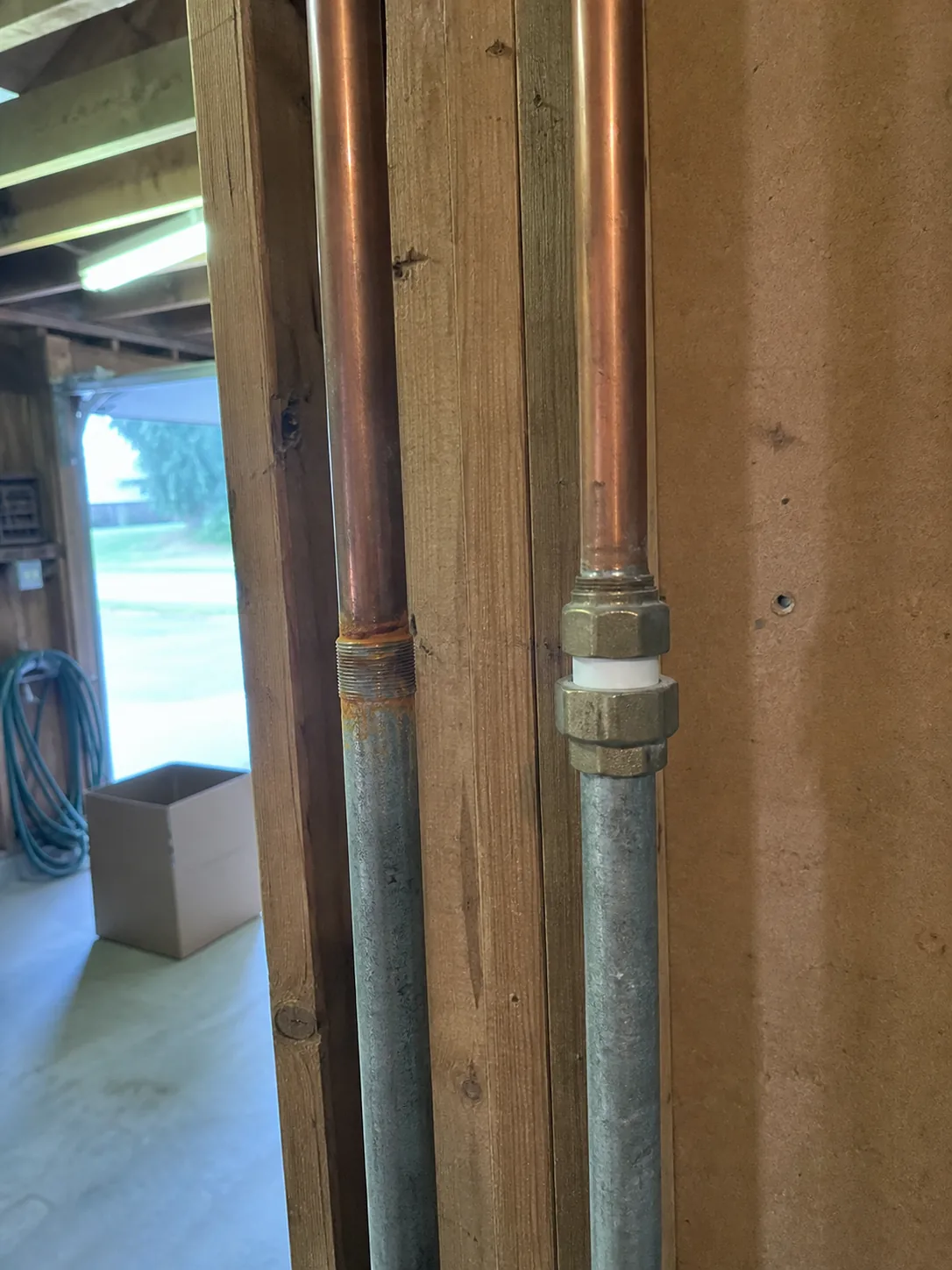
That is what a dielectric union does. It joins copper to steel while keeping the two metals physically and electrically separated, using a non conductive gasket and an insulating sleeve between the two halves. A dielectric nipple does the same job in a different form, with a non conductive lining running through the passage so the water inside is not in contact with both metals at once. A brass transition fitting is also common, because brass sits between copper and steel on the activity scale and moderates the reaction rather than driving it hard.
The point for an agent is simpler than the hardware. The defect is not that the house has two metals in it. Many serviceable houses do. The defect is that the two metals were joined directly, with nothing between them, when a fitting exists specifically to prevent that. When an inspector writes up a copper to galvanized junction, that is the finding: a transition made without the fitting the transition calls for.
For accuracy, dielectric fittings are not maintenance free either. Their insulating components degrade over decades and they accumulate their own internal deposits. A proper fitting is much better than none. It is not a permanent guarantee.
What an inspector actually documents, and where the salt air comes in
A home inspection is a visual examination of accessible components. On this subject, that means an inspector is documenting what can be seen at exposed junctions, and drawing a careful line at what cannot be seen.
What gets photographed and written up:
- Visible transitions between materials. Under the house, in the crawlspace, in the garage, at the water heater, and at any accessible stub where copper meets steel.
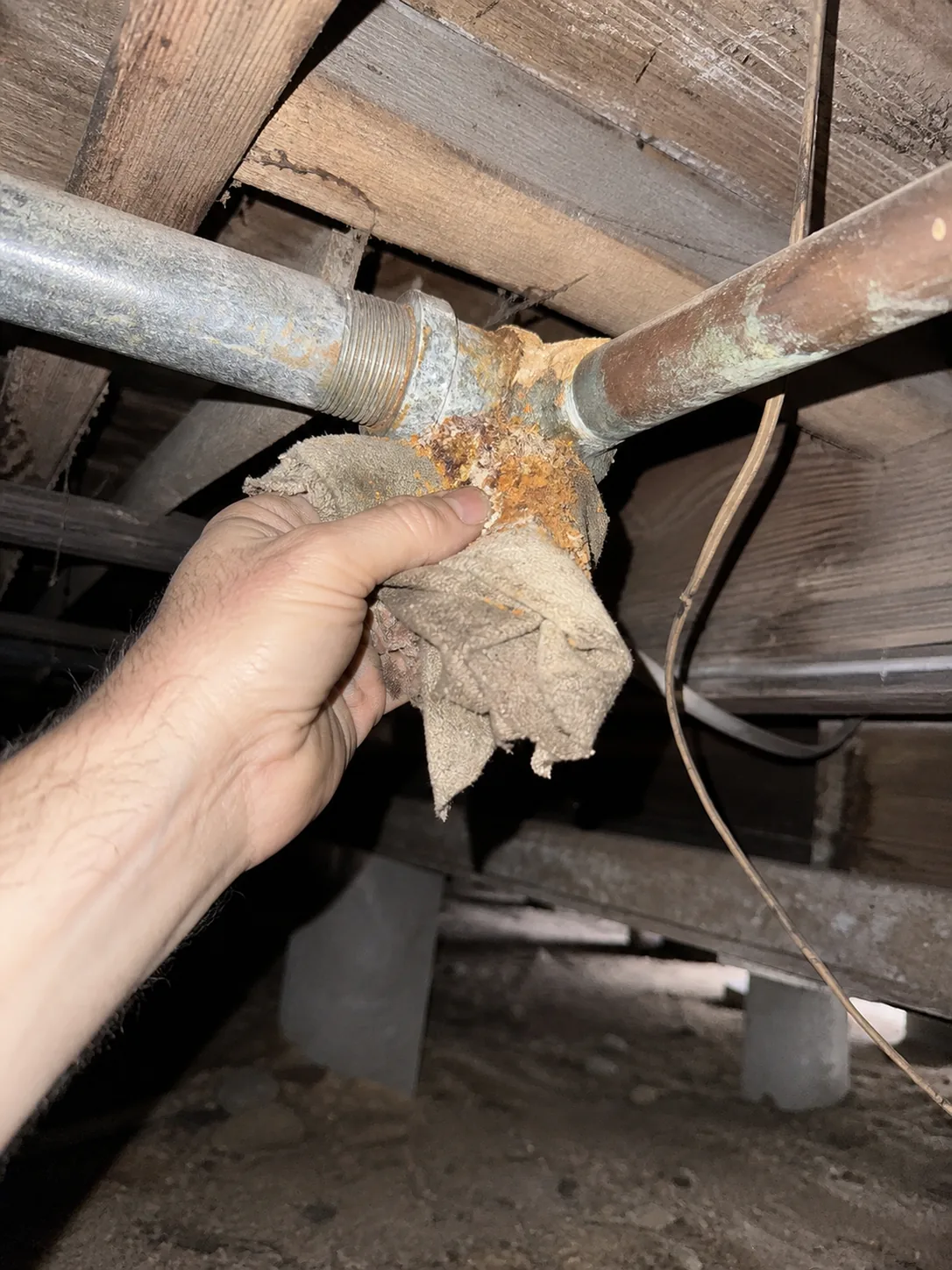
- Rust colored staining or a white to green mineral bloom concentrated at a fitting. The concentration is the tell. Corrosion blooming at a threaded junction with clean pipe on either side points at the junction, not the pipe.
- A visibly corroded or swollen threaded connection. Threaded joints fail from the inside out, and the outside evidence shows as a rough, thickened, flaking collar.
- Reduced or unbalanced flow. Weak flow at one branch, or flow that drops sharply when a second fixture opens, is worth documenting even though a symptom is not a diagnosis.
- Evidence of a partial repipe. Bright new copper in one area and original steel in another is itself a reportable observation, because it tells the buyer what to ask about.
Salt air matters here as an accelerant rather than a separate mechanism. The reaction inside the pipe is driven by the water. The exterior of the pipe, in a coastal crawlspace with damp marine air moving through it, corrodes faster than the same pipe would inland, and chloride bearing air is unkind to exposed threaded steel and to the fasteners and hangers around it. A Hermosa Beach junction tends to look worse, earlier, than an identical junction in a dry inland garage, with its supports degrading alongside it.
What an inspector does not do: cut into pipe, disassemble a fitting, perform a flow or pressure test to a plumbing standard, or scope the interior of a supply line. Internal pipe condition, remaining diameter at a junction, and the scope and cost of a repipe are all licensed plumber territory. A general inspector finds the junctions, documents their visible condition, and tells the buyer plainly that the inside of those fittings has not been seen by anyone.
Four plumbing findings this is not
Agents work with several plumbing articles in this library, and the boundaries matter, because the recommended next step is different for each.
This is not the Pasadena galvanized and cast iron piping guide. That article is about an entire aging pipe system reaching the end of its service life as a material, corroding and scaling internally throughout the house. Here the pipe material may be fine on both sides. The problem sits at the joint between two materials, and it exists because of the joint.
This is not the Tustin copper pinhole leak guide. Pinhole leaks are pitting corrosion within a single metal, driven by water chemistry and velocity, producing a small perforation and a visible leak. Galvanic corrosion at a bimetallic junction involves two metals, concentrates at a fitting, and typically restricts flow before it ever leaks.
This is not the Carlsbad salt air AC corrosion guide, which covers marine air attacking condenser fins, coils, and cabinets on cooling equipment. Different system, different repair path. The only shared element is coastal air, and here it plays a supporting role.
This is not the Porter Ranch water pressure and regulator guide, which covers system pressure and the pressure reducing valve. It shares one symptom, because a homeowner with weak flow will often describe it as a pressure problem. Weak flow with no bimetallic junctions is a pressure diagnosis and belongs there. Weak flow with a visible partial repipe starts at the junctions.
What agents should tell every buyer, and what to watch for at a showing
Six things worth saying plainly:
- A repipe is not automatically a full repipe. Ask how much was done, which year, by whom, and whether a permit or invoice describes the scope. “Copper” on a disclosure is not the same as “all copper.”
- The problem hides at the transitions, not mid run. Attention goes to the places where visible new work stops.
- Restricted flow usually comes before a leak. A house that has been getting slower at one fixture for two years is telling you something.
- A general inspection finds junctions and documents their condition. It does not measure what is left inside them. A licensed plumber does that.
- This is progressive. Deferring it means the cost is higher later, not equal.
- The fix is usually more targeted than a buyer fears. Replacing an accessible junction with a proper dielectric or brass transition is not the same job as repiping a house, though a house with many junctions and old steel behind the walls may genuinely be a repipe candidate.
At a showing, the tells are cheap to spot. Bright new copper running to a point and stopping. A threaded connection with a rust colored halo on the framing or slab beneath it. Chalky white or green deposits at a fitting near the water heater or laundry. Weak flow at a bathroom on the far end of the house, especially if it drops further when a second tap opens. Copper and steel both visible in the same under floor frame. None of these confirm anything alone, and none should be argued at the property. They are reasons to make sure the inspection specifically looks.
The negotiation playbook
Four realistic paths, depending on what the inspection turns up.
A small number of accessible junctions, everything else sound. The common and manageable case. A plumber’s quote to install proper transition fittings at the documented junctions is a defined number. Treat it as a repair item or a credit and move on.
Multiple junctions plus original steel behind finished walls. The question is no longer the fittings, it is what is left of the system they connect to. Ask for a licensed plumber’s evaluation of the full supply system before the contingency closes rather than guessing at a number.
An active flow complaint the seller has been living with. Ask for repair history. Several small plumbing calls over a few years plus a partial repipe in the file is itself information, and it supports asking for a plumber’s scope rather than a cosmetic repair.
A visible junction with staining but no functional symptom yet. This is where over-negotiating is a real risk. A condition exists and will progress, and it is worth a defined repair. It is not a reason to treat the house as having a failed plumbing system when nothing has failed.
In every path the useful move is the same: convert an open ended worry into a written scope from a licensed plumber. Vague plumbing fear kills deals. A number does not.
Quick FAQ
Can an inspector tell me how much life is left in the pipe? No. Nobody can, from the outside. Remaining internal diameter at a junction is only knowable by opening the fitting or by a plumber’s diagnostic work.
If the house was repiped, why is there still galvanized in it? Because the repipe was partial. Reaching pipe inside finished walls means opening walls, and many repipes stop at what is accessible.
Does a dielectric union solve it permanently? It interrupts the reaction, which is the important part. The fitting’s own insulating components can degrade over many years, so it is a correct repair rather than a permanent one.
Is this worse at the beach? The internal reaction is driven by the water, not the air, so the mechanism is the same anywhere. The coastal environment corrodes the outside of the fitting and its surrounding hardware faster, so the finding tends to present earlier and look more advanced here.
Is a partial repipe always a mistake? No. It is often a sensible, budget conscious repair. It becomes a defect when the transitions are made without the fittings that a transition between these two metals calls for.
The honest summary
Two dissimilar metals in direct contact with water between them form a small electrochemical cell, and the less noble metal gives itself up. In a house, that most often means galvanized steel joined straight to copper during a partial repipe, corroding closed from the inside at every transition while looking acceptable from outside. A fitting exists to prevent it. Its absence is the defect.
For a Hermosa Beach agent, the practical version fits in a sentence. When a disclosure says the house was repiped, find out how far the repipe went, and make sure the inspection looks hard at every place the new work meets the old.
Related reading
- Galvanized and Cast Iron Plumbing: A Pasadena Agent’s Guide for what happens when the pipe material itself, not the joint, is the problem.
- Copper Pinhole Leaks: A Tustin Agent’s Guide for pitting corrosion inside a single copper system.
- Water Pressure and the Pressure Reducing Valve: A Porter Ranch Agent’s Guide for diagnosing pressure complaints that are not caused by a restricted joint.
- Salt Air and AC Corrosion: A Carlsbad Agent’s Guide for what marine air does to cooling equipment.
- How to Read a Home Inspection Report in California for turning findings into priorities.
- Home Inspection Checklist for Los Angeles Buyers for the regional issues that come up most.
Our what’s included page covers the full plumbing scope of every Hermosa Beach inspection, including the infrared imaging that can help reveal moisture patterns behind a wall that a corroded junction has been feeding for months.
See what every inspection includes → · Read our FAQ → · Explore Hermosa Beach home inspections →
Booking an inspection in Hermosa Beach or anywhere in the South Bay is straightforward. Call 1-888-88-INSP-9 and we will document what is actually there, in writing, the same day.