Rancho Santa Fe Deck Ledger Attachment: The Structural Connection Buyers Miss
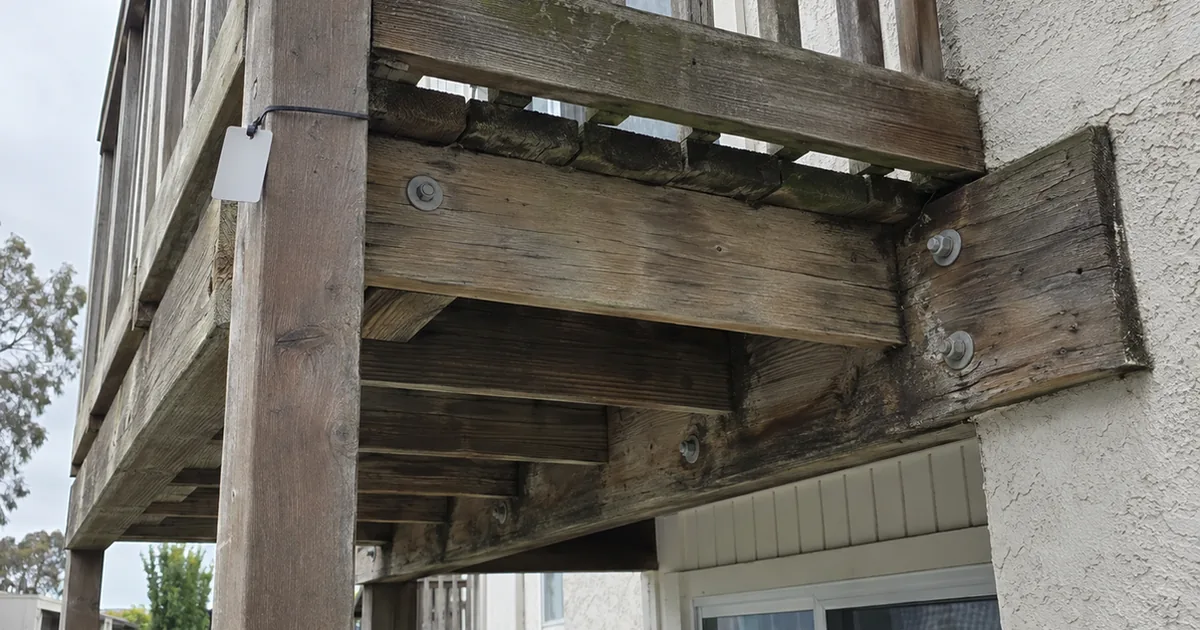
An elevated deck off a second-floor master suite overlooks a canyon. The deck was added by the second or third owner, probably fifteen or twenty years ago. The structure sits on posts at the front edge; at the back, a ledger board is bolted (or nailed, sometimes just nailed) directly to the rim joist of the house. When someone walks on that deck and it deflects slightly, or when you see daylight between the ledger and the house framing, that gap is the shape of a real structural problem. The ledger board is not properly fastened to carry live load. If it fails suddenly, the entire back edge of the deck pulls away from the house. People fall. Decks collapse.
This is not the same as surface waterproofing problems at the deck. Waterproofing (ponding water, membrane failure, water intrusion rotting the rim joist) is a different finding covered separately. This article is about how a deck is structurally attached to the house: the bolts, flashing placement, joist hangers, and what happens when that fastening is wrong.
That is the shape of this finding: a structural failure waiting to happen.
This guide is for the agent working Rancho Santa Fe and the surrounding San Diego County foothills. Similar issues appear in Del Mar, Solana Beach, and Encinitas, where hillside lots and multi-level decks are standard.
Why this matters for the agent
Deck ledger failure is a structural collapse hazard. The National Association of Home Inspectors records that improper ledger board attachment is responsible for a significant portion of residential deck collapses in the United States. Insurance companies are aware of this. Some carriers will not insure a home with a defective deck ledger or will exclude deck-related claims. Lenders may require an engineer’s report before closing. Buyers with young children or who entertain regularly become very sensitive to this finding once it is named.
The financial exposure is real. A properly engineered retrofit, which involves removing the ledger, installing through-bolts or lag bolts per current standards, installing flashing, and reattaching it, can cost $3,000 to $8,000 depending on deck size and existing fastening condition. On a high-end Rancho Santa Fe property where the deck is a primary selling feature, this negotiation can derail an offer or require a price adjustment.
Early identification (before offer or inspection) gives you room to shape the conversation with sellers.
What deck ledger attachment actually is
A deck is a cantilever structure. It has weight (live load and dead load) and it all has to go somewhere. Some of that load goes down through the posts at the front edge. The rest goes backward into the house, transferred through the ledger board.
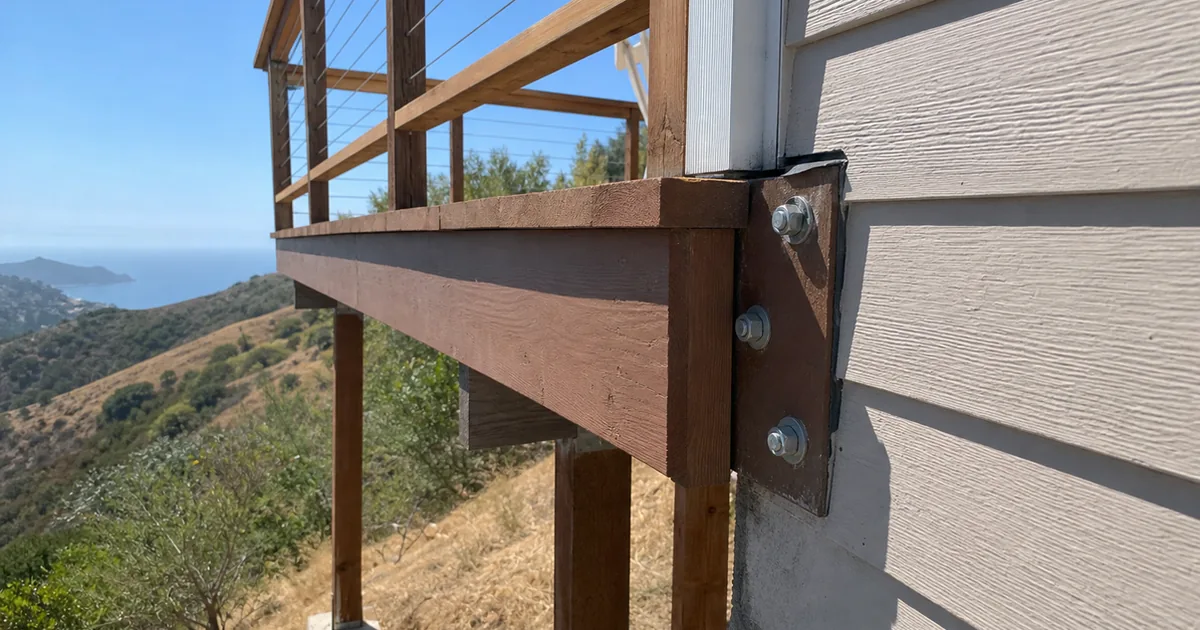
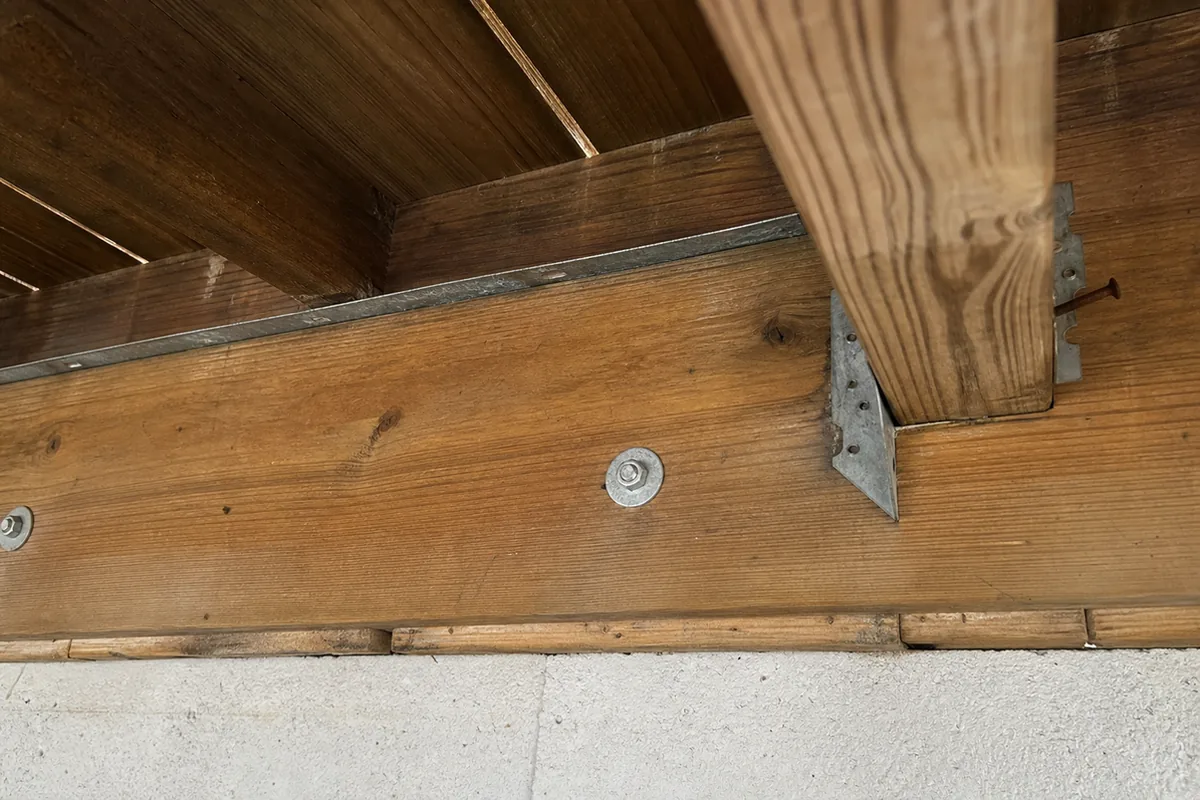
The ledger board is typically a 2x8 or 2x10 rim board, sandwiched between the deck frame and the rim joist (the perimeter beam that ties the house framing together). This ledger has to be fastened to the rim joist using fasteners, traditionally lag bolts, through-bolts, or modern coated deck screws rated for structural use. The fasteners must be spaced according to span tables in the International Residential Code and American Wood Council guidelines. Typical spacing is 16 inches on center for residential decks, sometimes tighter depending on joist span and load.
Directly behind the ledger, a metal flashing (usually L-shaped aluminum or galvanized steel) must be installed before the ledger is fastened. This flashing sits between the rim joist and the ledger and is lapped up and under the house exterior (usually into the rim or under the siding and house wrap). Its job is to shed water that may accumulate at that joint away from the connection, down and out, not into the rim joist behind the ledger.
Joist hangers tie the deck joists to the ledger and to the outer band board, distributing the load evenly instead of relying on end-bearing (which can crush wood or allow the joist to roll). The hangers themselves must be properly nailed or bolted per the hanger’s design rating.
All of this (ledger fastening, flashing placement, joist hanger installation) is prescriptive in modern deck construction standards. Most decks built after 2000 in California follow these rules. Older decks, especially those added by individual owners or built by unlicensed contractors, frequently do not.
What actually goes wrong
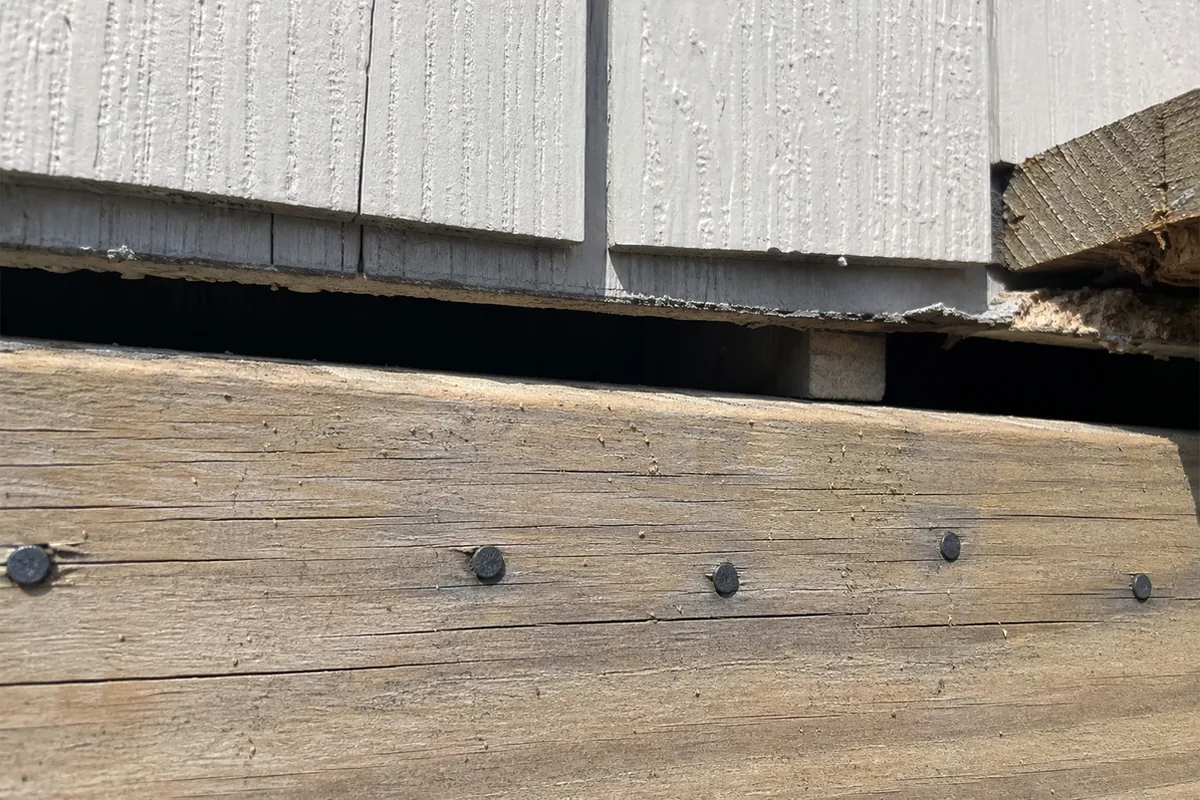
The most common failure is improper fastening. We’ve seen decks attached with nails instead of bolts. Nails fail in shear (the load pulling parallel to the fastener shaft) and can back out over time due to vibration. A deck built on sixteen-penny nails every sixteen inches on center will eventually shed those fasteners. The ledger pulls away from the house. The deck, fully loaded or even under moderate use, shifts or deflects. In worst cases, it collapses suddenly.
The second common problem is missing or improperly installed flashing. Flashing should be installed first, lapped up under the house exterior (or into the rim joist), then the ledger is bolted through it. Sometimes the flashing is installed backward, under the ledger facing outward (which directs water right into the connection). Sometimes it is omitted entirely. When water reaches the rim joist from behind (from condensation, runoff, or splash-back), the wood begins to decay. Decay is a symptom, but the structural problem that started it was improper or missing flashing letting moisture behind the ledger in the first place.
A third failure mode is ledger attachment to the wrong surface. Stucco, cladding, or house wrap is not structural. Ledger boards sometimes get fastened directly to these materials instead of through to the rim joist. The fasteners do not have solid bearing and can fail under load. Similarly, attaching to brick veneer (which is not structural bearing surface) is a common retrofit mistake on older Rancho Santa Fe homes.
Inadequate bolt spacing or undersized fasteners are less obvious but still structural defects. If bolts are spaced twenty-four inches on center when the span and load require sixteen inches, or if someone uses half-inch bolts instead of the required five-eighths-inch, the connection is understrength.
Decks built before prescriptive deck standards were adopted (roughly pre-2000 in most of California) often lack any structural fastening documentation. The builder may have used whatever fasteners were on hand. These decks need structural evaluation before they can be declared safe or remediated properly.
This is different from the deck surface and waterproofing side of things. A deck can have a rotted membrane or ponding water without structural fastening problems, and vice versa. This article is about the fastening. Both problems can exist on the same deck.
Schedule a Rancho Santa Fe inspection →
What agents should tell every buyer
-
Ledger fastening is life safety. The ledger board is the structural link between the deck and the house. Improper fastening can lead to deck failure or collapse. This is not cosmetic. It is a load-bearing connection.
-
The age of the deck matters. Decks built before 2000 frequently do not meet current standards for ledger attachment. Some use nails instead of bolts. Some lack flashing. Older decks need inspection and possibly structural evaluation.
-
Nails are not bolts. If the inspection report shows nails at the ledger instead of bolts or lag screws, this is a defect that must be corrected. Nails will fail under load.
-
Flashing goes behind, not in front. The metal flashing at the ledger should be installed between the rim joist and the ledger board, lapped up and under the house exterior. If it is missing, or if it is installed backward facing the deck, water will get behind the ledger and rot the rim joist.
-
Look for daylight. If there is a visible gap or space between the ledger board and the house structure (other than a small intentional air gap for ventilation, which is rare), the ledger is not in full contact with the rim joist. This is a red flag for improper fastening or deterioration.
-
Bolt spacing and size matter. Fasteners must be adequate in size (usually half-inch through-bolts or coated structural lag bolts) and spaced close enough (typically sixteen inches on center) to handle the deck’s load. If the inspection shows widely spaced fasteners or small bolts, a structural engineer should evaluate the connection.
Red flags during showings
- Deck bounces or deflects noticeably when someone walks on it. Minor deflection is normal; excessive bounce suggests the ledger fastening is not carrying load properly.
- Visible gap or daylight between the ledger board and the house rim. This means the connection has lost bearing.
- Fastener heads visible at the ledger. If they are large, flat-topped nails instead of bolt heads or lag-screw heads, the deck is attached with nails.
- No visible flashing where the ledger meets the house siding or rim. The flashing is usually a thin line of metal; if you see wood-to-wood contact at the ledger-to-house joint, flashing is probably missing.
- Deck age mismatch with the house. If the deck is significantly older than documented (hard to tell from the outside, but if the deck looks original to a 1980s house and the owner says it was added five years ago, something is off), get a closer look at fastening.
- Cracks or separation in the wood at the ledger, or wood that looks wet, stained, or soft. These suggest water has reached the rim joist.
The negotiation playbook
When the inspection identifies ledger fastening problems, buyers have three main paths forward.
Path one: Structural engineer evaluation. Hire a structural engineer to assess the deck and advise whether it is safe to use as-is or if work is required. This typically costs $500 to $1,500 and produces a written report. If the engineer says the deck is safe, the issue is resolved. If work is needed, the engineer specifies exactly what that work is.
Path two: Contractor retrofit. If the engineer recommends repair (or if the agent and buyer agree that repair is the practical choice), a qualified contractor removes the existing fasteners, installs proper flashing if missing, installs new through-bolts or structural lag bolts at the proper spacing, and reinstalls the deck. The deck stays functional throughout in most cases. Cost depends on deck size, existing condition, and local labor rates; budget $3,000 to $8,000 for a typical Rancho Santa Fe deck.
Path three: Credit or price adjustment. If the seller and buyer negotiate to close as-is with the understanding that the buyer will handle the retrofit, the buyer typically wants a credit at closing or a price reduction to cover the cost. This is common and usually accepted; it gives the buyer choice over contractor and timing.
Combination approach: Some buyers ask for an engineer evaluation and an upfront credit so they can choose their own contractor if work is needed. This is reasonable and protects both parties.
The key is to name the problem early and clearly, then give the seller a professional path to resolution (engineer report) before demanding a dollar amount.
How the inspection actually catches it
A home inspector approaches the ledger with a simple checklist. First, they look for the fasteners. Are they bolts, lag screws, or nails? Bolt heads are round and typically half-inch diameter; lag-screw heads are larger and square or hex-shaped; nails are thin and flat or slightly rounded. Inspectors use a flashlight and sometimes a small probe to identify fastener type and spacing.
Second, they check for flashing. Metal flashing should be visible at the ledger-to-house joint, typically as a thin horizontal line running the length of the ledger. If no flashing is visible and the joint is just wood-to-wood, flashing is missing.
Third, they examine contact between the ledger and the rim joist. A straight edge (or just a visual check) can reveal gaps. If the ledger is not in full bearing on the rim joist, that is documented.
Fourth, they look for signs of water intrusion or decay at and around the ledger: stains, soft wood, mold, or cracks radiating from the connection. These are secondary evidence that water has been reaching the rim joist.
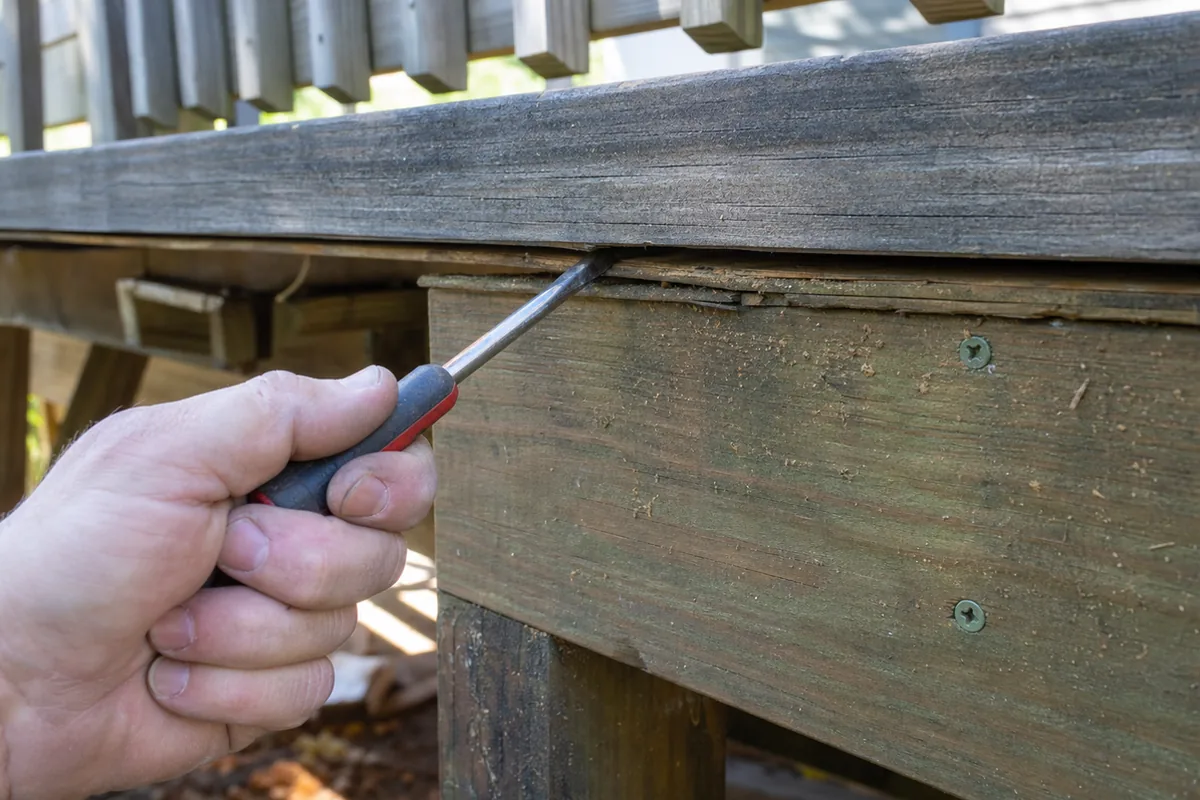
Finally, they test the deck for excessive movement or deflection by walking on it and noting how much it gives. A slight bounce is normal; significant deflection is a red flag.
The inspection report will typically state what type of fastening was observed, note the spacing of fasteners, describe whether flashing is present and properly installed, and note any gaps or signs of deterioration. If problems are found, the report will recommend a structural engineer evaluation or contractor repair depending on the severity.
Quick FAQ
Q: How can I tell if a deck’s ledger is fastened with bolts or nails? A: Look at the fastener heads at the ledger board where it meets the house rim. Bolt heads are round, usually half-inch or five-eighths-inch diameter, and sit flush. Lag-screw heads are larger and hex or square-shaped. Nails are thin and have small, flat heads. A flashlight helps. If you cannot get a close look from the ground, an inspector can do a detailed examination.
Q: What is flashing and why is it behind the ledger, not in front? A: Flashing is a thin metal (usually aluminum or galvanized steel) barrier that sheds water. It sits between the rim joist and the ledger board, lapped up and under the house exterior. This way, any water that drips down the back of the ledger is directed away from the rim joist, not into it. If flashing is missing or installed backward, water goes behind the ledger and rots the rim joist.
Q: If the inspection says my deck ledger is missing flashing, do I have to fix it? A: Yes. Missing flashing is a structural defect that allows water to reach the rim joist and causes decay over time. Repair requires removing the ledger, installing flashing properly, and reattaching the ledger. This can be a negotiation point with the seller before closing. After purchase, it becomes your responsibility.
Q: Can an older deck with a nailed ledger be safe if it has never failed? A: Not necessarily. Nailed ledgers fail under load or vibration. Just because a deck has not collapsed yet does not mean it is safe. Inspectors recommend treating a nailed ledger as a defect and either replacing it with bolts or having a structural engineer evaluate it formally.
Q: How much does it cost to retrofit a deck ledger with proper bolts and flashing? A: For a typical 12-by-14-foot deck on a Rancho Santa Fe hillside home, a contractor retrofit costs $3,000 to $8,000 depending on existing fastening condition, deck complexity, and local labor rates. A structural engineer evaluation (to determine exactly what is needed) typically costs $500 to $1,500. These can be negotiation points with the seller or credits applied at closing.
The honest summary
Deck ledger attachment is a structural life-safety issue that many buyers and some agents overlook until the inspection report names it. In Rancho Santa Fe, where elevated decks are common and homes have been renovated over decades with varying levels of contractor expertise, ledger problems are frequent. Nailed ledgers, missing flashing, and undersized fasteners all create collapse risk.
The good news: structural engineers know how to evaluate these connections and contractors know how to fix them. The problem is fixable. The key is naming it early, understanding what the inspection means, and negotiating a clear resolution before closing.
When you encounter a ledger problem during a listing appointment or inspection, explain it to the buyer in plain terms: the ledger is the structural link between the deck and the house, improper fastening can cause the deck to fail, and repair is straightforward. Give the seller a professional path to resolve it (engineer report, contractor retrofit, or negotiated credit). This protects the buyer, keeps the sale moving, and avoids surprises after closing.
See what every inspection includes → · Read our FAQ → · View a sample report → · Explore Rancho Santa Fe home inspections →
Related reading
- Manhattan Beach Deck & Balcony Waterproofing: The Surface Problem You Can’t Ignore. This article covers deck membrane failure, ponding water, and decay at the ledger from long-term water intrusion; it is the surface and waterproofing side of deck failure, distinct from structural fastening.
- West Hollywood Balcony Inspection: SB 326 and Your Duty to Disclose. California’s balcony inspection law requires disclosure of certain defects; ledger and deck structural issues may trigger this requirement depending on the property.
- La Jolla and Mount Soledad: Landslide Risk in San Diego County Hillside Homes. Rancho Santa Fe hillside properties face similar terrain risk as other elevated San Diego County communities; understanding structural context helps frame why elevated decks and their attachments matter.
- How to Read a Home Inspection Report in California. A guide to understanding inspection findings, including what structural defects mean and how to respond to them in offers and negotiations.