Where the Water Goes in Tarzana: An Agent’s Guide
The house was in the Tarzana hills, south of the boulevard, and it showed beautifully in September. A wide flagstone patio wrapped the back of the home, the planters were full, and the yard sloped up into the hillside behind it the way half the lots up there do. Nothing looked wrong, because in September in Los Angeles nothing ever does.
What we found was a house that had been quietly set up to collect water. The patio had been laid at some point after the home was built, and it pitched back toward the wall instead of away from it, so every square foot of that flagstone was aimed at the foundation. Two downspouts ended in a splash block six inches from the stucco. The area drains that were supposed to take water off the upper yard were packed solid with silt and leaf litter, which meant that during a real storm they were not drains, they were just holes. There was staining along the base of the wall where this had been happening for years, and a crawlspace that smelled like it had never fully dried out.
None of that is exotic. It is the most common serious finding we write up in Tarzana, and it is the one agents are most likely to walk past, because it does not look like a defect. It looks like landscaping.
This guide is for the agent working Tarzana and the west valley, including nearby Encino and Woodland Hills, where the same hillside-and-flats split sends water the same two wrong ways. Here is why the water matters, what the code actually asks for, and how to keep a patio or a downspout from turning into a foundation claim.
Why this matters for the agent
Here is what is at stake. Water is the most expensive thing that happens to a house, and grading is the cheapest place to stop it. Everything a buyer is afraid of in a foundation report, movement, cracking, damp crawlspaces, soft subfloor, mold, starts with soil that is wet when it should be dry. Get the water away from the building and most of those conversations never happen. Leave it, and the buyer inherits a problem that gets more expensive every winter they own the house.
The timing is what makes this an agent’s problem specifically. Los Angeles gets most of its rain in a handful of days, and the rest of the year the evidence hides. A drainage defect that will flood a crawlspace in February is invisible at a July showing, so buyers routinely close on it without ever seeing what it does. That is also the good news. Grading and drainage corrections are among the least expensive meaningful repairs in a transaction, far cheaper than the foundation work a buyer will be quoted later if nobody fixes the water. An agent who can look at a patio and a downspout and know what they are looking at is protecting the deal and the client at the same time.
Tarzana gets this problem twice, in opposite directions
Tarzana is really two housing markets, and Ventura Boulevard is the seam. South of the boulevard the ground climbs into the Santa Monica Mountains, and the homes go with it, onto graded pads and terraced yards around the country club and canyon streets. North of the boulevard the ground flattens out into valley floor, and the streets fill with ranch and mid-century homes on level lots. Both sides have drainage problems. They are not the same problem.
On the hillside, water arrives with momentum. Rain that falls on the slope above a house has to get around the house, and the original builder solved that with grading, swales, and drains. What we find decades later is that the solution has been undone by living in the place. Somebody added a patio, a pool deck, a planter wall, a fire pit, a putting green, and each of those changed where the water goes. Area drains fill with silt and nobody knows they are there. Terraced yards that used to shed water now hold it. The hillside is still sending water at the house, but the paths that used to carry it away are gone.
On the flats, the problem is the opposite. Nothing has momentum, and nothing has anywhere to go. A level valley lot has no natural fall, so the drainage away from the foundation has to be built on purpose and then maintained on purpose. Instead, soil gets added to the beds year after year until it is piled against the stucco. Lawns get built up. A concrete walkway gets poured flat, or slightly the wrong way. Sprinklers spray the wall three times a week. There is no storm event that dramatizes it, just soil that is damp against the building every single day of the year. The house on the flats does not flood. It just never dries.
What the code actually asks for, in numbers you can use
The requirement is simple enough that an agent can hold it in their head. Under the California Residential Code, the finished ground next to the house is supposed to fall at least six inches over the first ten feet away from the foundation, and lots are supposed to be graded so surface water runs away from the building. Where a fence, a lot line, a wall, or a slope makes that impossible, which happens constantly on Tarzana hillside lots, the code expects drains or swales to be built to carry the water away instead. Hard surfaces within ten feet of the house, a patio or a walkway, are supposed to slope away from the building by at least two percent, which is about a quarter inch of drop per foot.
Those numbers give you something to do at a showing. Six inches over ten feet is a slope you can see once you know to look for it. Two percent on a patio is subtle, but water pooling near the wall after someone washes a car tells you the same thing. We are not the ones who design the fix, and we do not certify code compliance. What we do is tell a buyer plainly when the ground next to their house is pointed the wrong way.
Schedule a Tarzana inspection →
What actually goes wrong
The failures repeat, and once you have seen them you cannot stop seeing them.
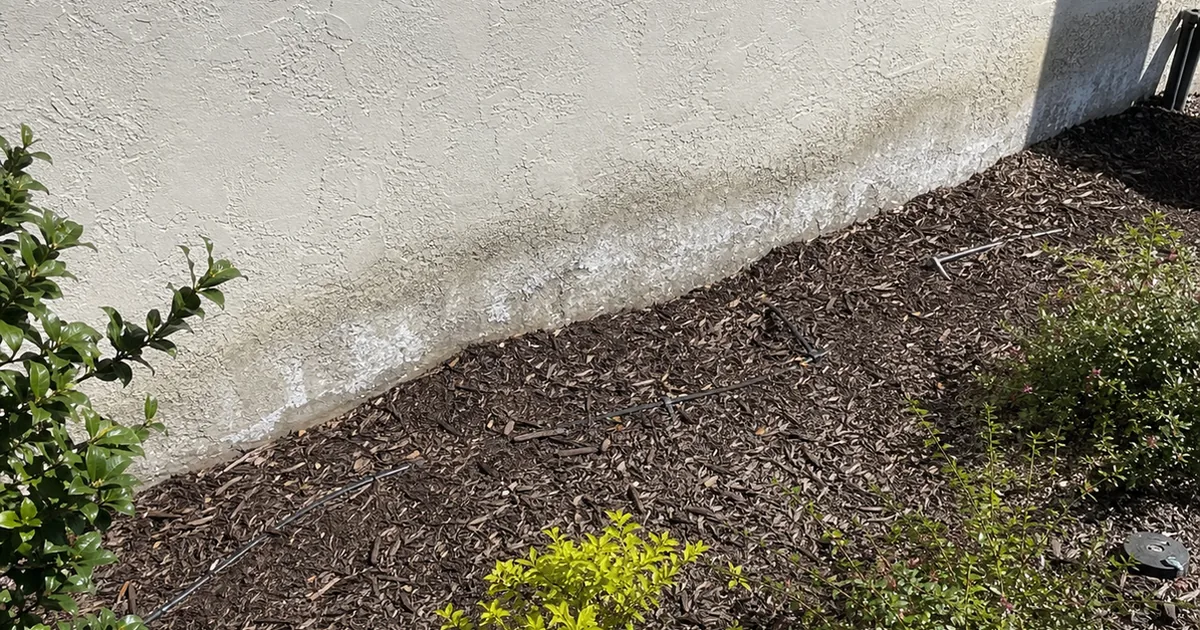
Negative grading is the headline. Soil, mulch, or a raised planter bed sits high against the wall and slopes back toward it. It is almost always the result of good intentions, decades of adding mulch and topsoil to the beds, and it is the single most common drainage defect in this market.
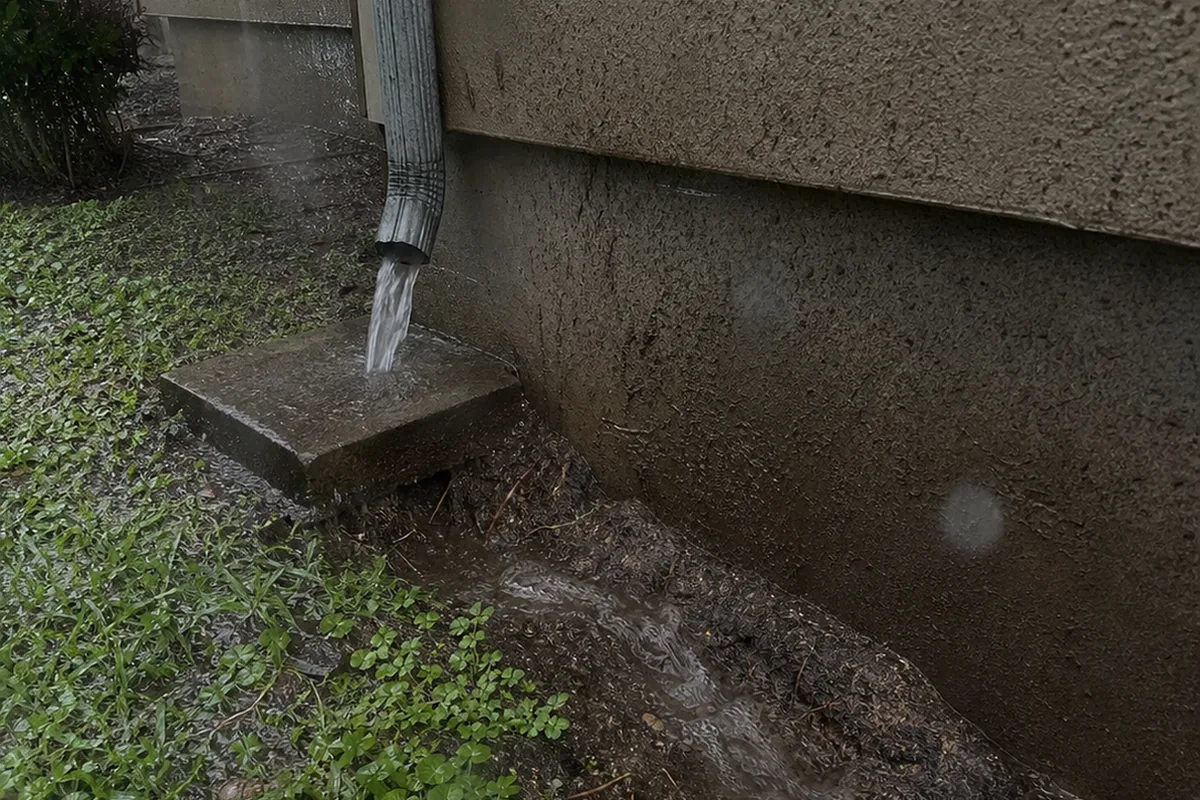
Downspouts that discharge at the foundation are the second. A roof is an enormous water collector, and every gutter on it is designed to take that water somewhere. When the downspout ends in a splash block against the wall, the gutter has simply concentrated an entire roof plane’s worth of rain into one spot next to the footing, which is worse than having no gutter at all.
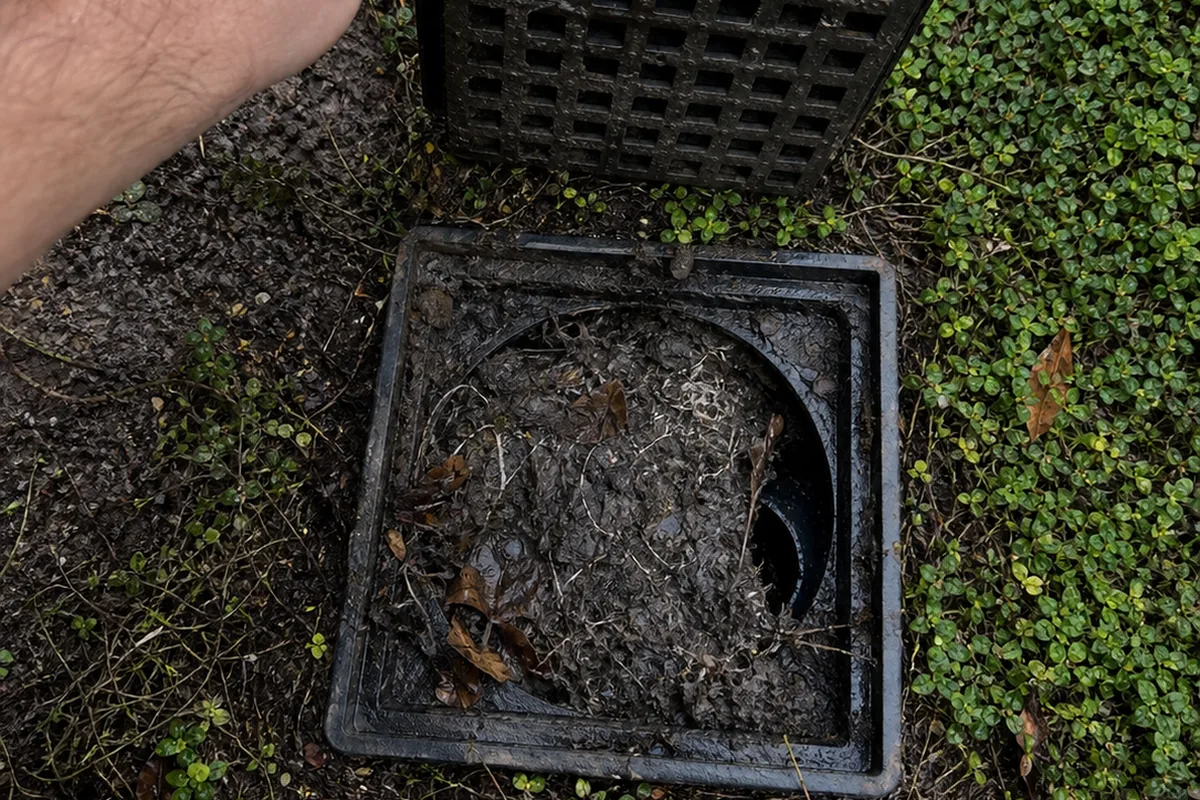
Buried and blocked drains are the third, and they are the one that ambushes hillside buyers. Area drains and their underground piping are out of sight, so they get forgotten, and silt, roots, and leaves fill them over the years. On a hillside lot those drains are not a convenience. They are the reason the yard works. When they stop, the water they used to carry has to find its own way, and it finds it under the patio and against the foundation.
Hardscape pitched the wrong way is the fourth. Patios, pool decks, and walkways added after the original build are frequently laid flat or pitched slightly toward the house, and once concrete is set the mistake is permanent until somebody breaks it out or adds a channel drain.
Irrigation is the quiet fifth. Sprinkler heads aimed at the wall, or a drip line under a bed that sits against the stucco, keep the soil beside the foundation wet year round in a place that only rains a few days a year. It is the easiest thing on this list to correct and the one nobody thinks about.
Retaining walls belong in this conversation only at the edges. A wall that holds back soil is a structural element with its own failure modes, and it is a different subject from where the surface water goes. If a Tarzana hillside property has walls that are leaning, cracking, or weeping, that is an engineer’s question, and our guide to hillside retaining walls covers what that looks like. Here we are talking about the water on top of the ground, not the soil behind the wall.
What agents should tell every buyer
When a buyer is under contract in Tarzana, give them these points before the inspection.
- Look at the dirt, not the plants. A beautiful bed can be the defect. What matters is whether the soil is high against the wall and which way it slopes.
- Follow every downspout to its end. If it stops at the house, it is aiming a roof at the foundation.
- On a hillside lot, ask where the area drains are and when they were last cleared. If the seller does not know, assume they are full.
- Understand that a dry-season showing tells you nothing. The house is in its best disguise from May to November.
- Know the cost order. Regrading a bed, extending a downspout, and clearing a drain line are cheap. Foundation repair, mold remediation, and subfloor replacement are not. The whole point is to spend the small money.
- Ask what has been added to the yard since the house was built. Every patio, deck, and planter changed the drainage, and somebody had to get it right.
A buyer who hears this from you stops seeing landscaping and starts seeing a water system, which is what it is.
Red flags during showings
You can catch most of this without any equipment at all. Watch for these in Tarzana homes.
- Soil, bark, or mulch piled up so it touches the stucco or siding, especially where a bed slopes toward the house.
- A downspout that ends at the wall, or one that has been cut short, or a stain running down the wall under a gutter joint.
- Grates in the yard that are full of leaves, sunk below the soil line, or paved over entirely.
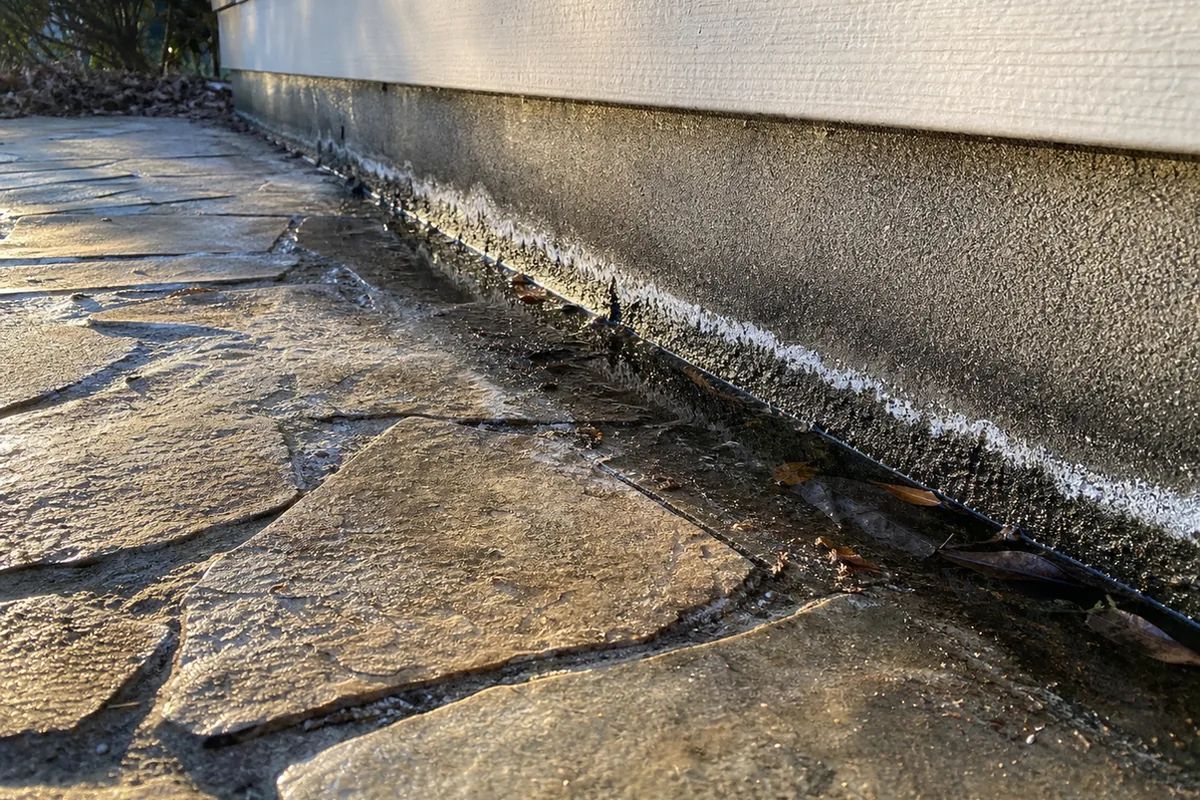
- A patio or walkway with a dip, a puddle stain, or an efflorescent white line where water sits against the house.
- Cracked or heaved hardscape right at the foundation, which often means the soil under it has been getting wet and moving.
- A musty smell at a floor vent or near a crawlspace hatch, which is what a wet subfloor smells like in a dry month.
- Fresh paint on the bottom two feet of an exterior wall, or on interior baseboards in one room only.
If we see these, we document them and tell the buyer what they mean.
The negotiation playbook
When drainage findings surface in Tarzana, the deal usually moves one of a few ways.
The first path is seller-corrects-the-easy-ones. Pulling soil back off the wall, extending downspouts away from the house, hydro-jetting the area drains, and turning the sprinklers away from the stucco are small jobs. A cooperative seller will do them, and they should, because these are the corrections that stop the damage from continuing while everyone argues about everything else.
The second path is a credit for the drainage work. Where the fix means adding a channel drain, cutting a swale, or replumbing the downspouts into a proper subsurface line that daylights away from the house, that is a contractor’s bid and it is usually modest. Take the credit and do the work before the first storm. On a hillside lot this is the one to insist on.
The third path is break-it-out-and-repour, which comes up when a patio or pool deck is pitched into the house. That is a bigger number, and it is a real negotiation. It is also the one buyers most want to defer, and the one that quietly keeps working against the foundation while they do.
The fourth path is when the water has already done something. If the crawlspace has been wet for years, if the subfloor is soft, if there is fungal growth on the framing, the conversation has moved past grading. Now the buyer needs a contractor’s scope and possibly a structural opinion, and the drainage correction is the thing that has to happen first so the repair does not simply happen again. We will say so plainly when we see it. We have watched buyers fix the damage and skip the water, and they end up paying for the same repair twice.
How the inspection actually catches it
Drainage is one of the few things where an inspection in the dry season can still tell the truth, because water leaves a record. We walk the whole perimeter and read the grade at the wall, not from the driveway. We check where every downspout actually ends. We look for the drains, lift what we can, and note whether they are open or gone.
We read hardscape for slope and for the stains that show where water has been standing. Then we go where the evidence is. In a crawlspace, damp soil, staining on piers, and efflorescence on the foundation tell you what has been happening outside for years, and thermal imaging picks up cool moisture patterns at the base of walls and along floors that a flashlight walks right past. Our guide on infrared scanning explains what those scans actually show. On a hillside property, drone imagery lets us read the whole yard and the terraces from above, which is the only way to see the shape of the ground as water sees it.
What we do not do is design your drainage system or certify code compliance. We do not pretend a home inspector is a civil engineer. We tell you where the water is going, show you what it has already done, and point you to the trade that fixes it. And if the finding is worse than a landscaping problem, we will say that out loud rather than bury it on page forty.
Quick FAQ
How much slope is the ground supposed to have next to the house? The California Residential Code asks for at least six inches of fall in the first ten feet away from the foundation, with the lot graded so surface water runs away from the building. Hard surfaces like a patio within ten feet should slope away by at least two percent. Where a wall, a slope, or a lot line makes that impossible, drains or swales are expected to do the job instead.
Is a wet crawlspace always a drainage problem? Not always, but it is the first thing to rule out. Water can also come from a plumbing leak or from a naturally high water table, which is a different mechanism entirely and is covered in our Camarillo ground moisture guide. In Tarzana, the overwhelming majority of what we find is surface water that was never sent away from the house.
The seller says the drains work. How would anyone know? Run water into them and watch. A drain that backs up, or one that takes water and never discharges anywhere you can find, is not working. On a hillside lot, ask for a receipt from whoever last cleared the line. Silt and roots fill these over the course of years, and the failure is silent until the day it matters.
My buyer wants to fix this after they move in. Is that reasonable? The cheap items should not wait. Extending a downspout, pulling soil off the wall, and clearing a drain are a weekend, and every storm before they are done is another storm of damage. The bigger work, cutting in a channel drain or repouring a patio, can be scheduled, as long as it happens before winter rather than after the first time the crawlspace floods.
Does this matter as much on the flats as it does in the hills? Yes, in a different way. Hillside lots fail dramatically during a storm. Flat lots fail slowly, because soil piled against the wall and sprinklers hitting the stucco keep the foundation damp all year in a climate that is otherwise dry. The flats problem does less at once and more over time.
The honest summary
Tarzana asks the same question on both sides of Ventura Boulevard, and it is a simple one. When it rains, where does the water go. On the hillside the answer used to be the drains and the swales, and on a lot of properties those have quietly stopped working. On the flats there was never much of an answer, so the soil and the sprinklers and the flat walkway decide, and they usually decide badly.
This is not a glamorous finding, and it does not photograph like a cracked beam. It is just the thing that causes the cracked beam, three winters from now, on somebody else’s dime. We will read the grade at the wall, follow the downspouts, find the drains, and show your buyer on a thermal scan what the water has already been doing. Fix the water first and the expensive problems mostly do not arrive. That is the job.
See what every inspection includes → · Read our FAQ → · Explore Tarzana home inspections →
Related reading
- Who Owns That Wall: A Mission Viejo Tract Slope and Retaining Wall Guide: the other half of the water-and-slope story, where pressure behind a wall rather than runoff across a lot is the question.
- Eastvale Stucco and Weep-Screed Moisture Guide: what happens when grading buries the drainage detail at the base of the wall itself.
- French Drains and Subsurface Drainage in Lemon Grove: the below-grade companion to this article’s surface-water focus, water moving through the soil rather than across it.
- Why Infrared Scanning Matters in California Homes: how thermal imaging finds the moisture that grading and drainage findings predict.
- How to Read a Home Inspection Report in California: what the findings mean and how to prioritize them.
- Porter Ranch Water Pressure and Regulator Guide: the water pushing on a house from the inside, the plumbing companion to what grading manages outside.
- Driveway and Flatwork Trip Hazards in Lakewood. What tree roots do to the concrete, a different exterior subject from surface-water drainage.
- Roof Drainage and Gutter Systems in Lake Balboa. Water still coming off the roof, the system that determines how much water reaches grade in the first place.
- The missing diverter at the roof-wall joint in Whittier. Where drainage meets the building envelope, a missing kick-out flashing sends roof runoff behind the wall instead of away from it.
- Downey Foundation Dampproofing and Waterproofing Guide. The below-grade wall coating question, the companion to surface grading once the water actually reaches the foundation.