An industry update from Inspection.re, premium home inspections across California.
The new electrical notice starts being delivered January 1, 2026. It came from Senate Bill 382, which the Governor approved on September 22, 2024.
That timing has already produced bad citations. It has also produced a larger mistake. The law requires a written notice. It does not require an electrical inspection, a new panel, a service upgrade, or any electrical work before a sale closes.
The real estate SB 382 was signed in 2024, not 2025
Senate Bill 382 was authored by Senator Becker and enacted as Chapter 443 of the Statutes of 2024. It added Civil Code sections 1102.6i and 1102.6j.
Section 1102.6i took effect January 1, 2025. The disclosure duty created by that section begins January 1, 2026. Those dates are different, and the gap is deliberate.
A great deal of published guidance calls the measure “SB 382 (2025)” or implies that it was signed in 2025. It was not. That is more than a citation error, because there is another Senate Bill 382 in the 2025 to 2026 legislative session. That bill concerns vehicle repossession agencies. It amends the Business and Professions Code and the Vehicle Code. It has nothing to do with residential property disclosures.
Searching for “SB 382” without the session year can send an agent, buyer, or seller directly to the wrong bill. Referring to Civil Code sections 1102.6i and 1102.6j avoids that problem. The code citations identify the two real estate duties without ambiguity.
Inspection.re also covers the measure in its guide to 2026 California laws affecting home inspections and real estate agents. When you discuss the disclosure in an email, transaction note, or client conversation, use the code section rather than the bill number.
Civil Code 1102.6i requires a notice, not an inspection
On or after January 1, 2026, the seller of real property subject to Civil Code Article 1.5, or the seller’s agent, must deliver a disclosure containing a specific notice to the prospective buyer. Article 1.5 governs disclosures upon the transfer of residential property.
The required language is not a general suggestion that each brokerage can rewrite. The statute supplies the notice: “In a purchase of real property, it may be advisable to obtain an inspection by a qualified professional of the electrical system(s) of any buildings, including, but not limited to, the main service panel, the subpanel(s), and wiring. Substandard, recalled, or faulty wiring may cause a fire risk and may make it difficult to obtain property insurance. Limited electrical capacity may make it difficult to support future electrical additions to the building(s), such as solar generation, electric space heating, electric water heating, or electric vehicle charging equipment.”
The operative phrase is “may be advisable.” The statute requires a piece of paper to change hands. It does not require the seller to obtain an electrical inspection. It does not require the buyer to order one. It does not require anyone to replace a panel, upgrade the service, repair wiring, or remediate a reported condition before closing.
The law also does not make the sale contingent on the electrical system. A seller who delivers the required notice and does nothing else has complied with this section. Early commentary that presents section 1102.6i as a retrofit before sale requirement is adding an obligation that does not appear in the text.
If a transaction raises a legal question beyond the words of the statute, send that question to counsel. Do not convert a disclosure notice into a construction mandate through loose client advice.
Homes under three years old do not receive the electrical notice
Recently built homes are expressly carved out. Section 1102.6i states that it does not apply to the sale of a building within three years of the issuance of the certificate of occupancy.
The date of the certificate of occupancy therefore matters. The exemption is not framed around the appearance of the property, the age claimed in marketing, or the date of a renovation. It applies to a building sold within three years after that certificate was issued.
That line places the notice on older housing stock, where the electrical conditions named in the statute actually live. A remodeled kitchen does not tell you what is inside the main panel. New flooring does not identify branch wiring behind the walls. Fresh paint around a subpanel does not establish the panel’s rating, available capacity, or internal condition.
Agents handling transfers on or after January 1, 2026 need to distinguish a genuinely recent certificate of occupancy from a house that merely looks new after cosmetic work.
Recalled points buyers toward panels that may still be in service
The safety clause identifies three different categories: substandard, recalled, or faulty wiring. The word recalled is doing specific work.
Certain electrical panel lines have a long-standing reputation for failing to trip, and those panels remain in service in California houses decades later. Inspection.re has a dedicated guide to Federal Pacific and Zinsco panels and a separate field guide covering older residential electrical panels.
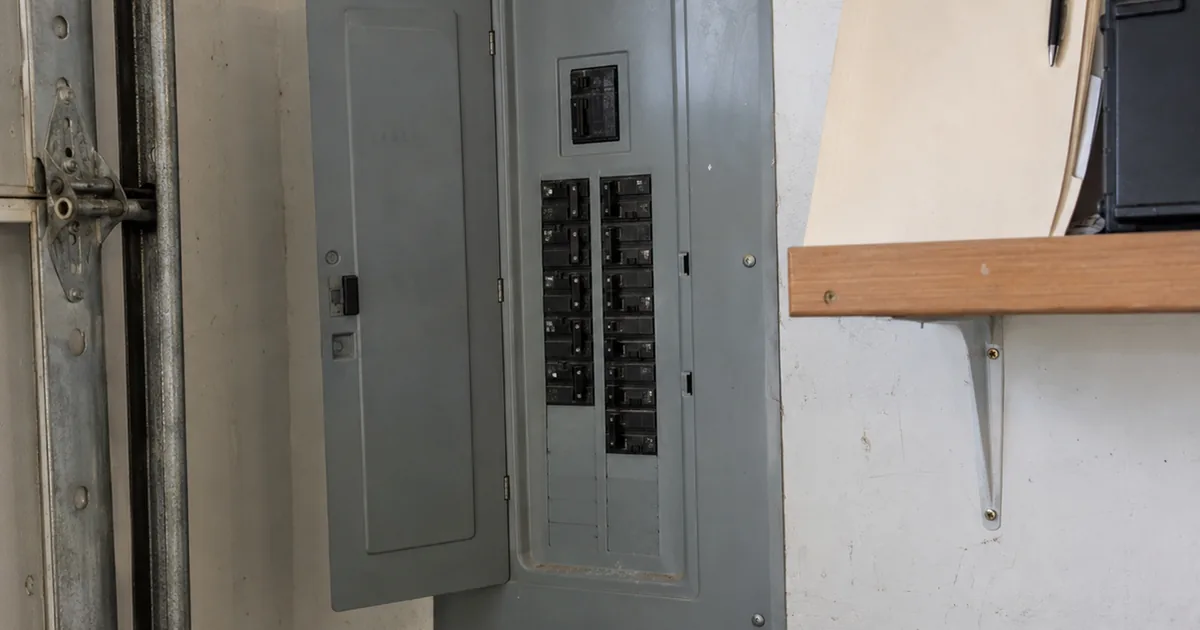
The panel cover and breaker labels tell only part of the story. When it is safe to do so, an inspector may pull the dead front cover and look at the actual terminations. Directory labels are frequently wrong. A neatly typed schedule does not prove that the listed breaker serves the room named beside it.
Visible findings can include two conductors under a breaker terminal rated for one, commonly called a double tap. The issue and its reporting context are covered in Inspection.re’s guide to double-tapped breakers. An inspector may also see a bonded neutral in a subpanel, missing knockout covers, or scorching and heat discoloration around terminals.
Branch wiring presents a different set of limits. Aluminum branch circuit wiring and surviving knob and tube wiring can remain behind later improvements. The absence of a finding in one accessible location is not a statement about the entire house.
That distinction matters in older properties, whether the inspection is scheduled through Inspection.re in San Francisco, Oakland, or San Jose. The inspection reports visible conditions. It does not turn concealed wiring into visible wiring.
An inspector documents the condition, the carrier decides insurability
The notice says substandard, recalled, or faulty wiring may make it difficult to obtain property insurance. Agents will feel this clause before they feel the others, because insurance has its own decision maker and its own timeline.
Insurability is decided by carriers. It is not decided by the inspector, the seller, the buyer’s agent, or section 1102.6i. An inspector can identify and document a visible panel, wiring material, damaged component, or access limitation. The inspector cannot rule on whether a carrier will issue, renew, price, or condition a policy.
Keep those conversations separate. One conversation concerns the physical condition reported at the property. The other concerns what a particular carrier will do with that information.
Do not promise that a finding will be accepted. Do not promise that it will cause a denial. The statutory notice itself uses the words may make it difficult, not a guaranteed insurance outcome.
A buyer reviewing an inspection from Corte Madera or Vacaville should also know how observations, limitations, and recommendations appear in the document. Inspection.re’s guide to reading a California home inspection report explains that reporting structure. The carrier’s decision remains separate from it.
A safe electrical service can still be too small for the buyer’s plans
Limited capacity is not the same issue as defective wiring. A service can be safe in its present configuration and still be too small for what the buyer intends to add.
Section 1102.6i names four future additions plainly: solar generation, electric space heating, electric water heating, and electric vehicle charging equipment. That list makes the notice forward-looking. The question is not limited to whether the existing lights, receptacles, and appliances operate today.
During an inspection, the service rating stamped on the equipment may be noted. The inspector may also report whether the panel is full. A full panel is a real constraint on adding equipment later, even when no current safety defect is identified. Inspection.re discusses this distinction in its guide to undersized electrical service.
Access matters too. A main disconnect that cannot be reached or clearly evaluated presents a different reporting problem from a disconnect that is visible and accessible. The main electrical disconnect accessibility guide addresses that condition.
The notice does not say that every buyer planning an electric vehicle charger needs a service upgrade. It says limited capacity may make future additions difficult. Inspection findings can give the buyer more information about the existing equipment. They do not substitute for the separate evaluation of a proposed installation.
For agents, this changes the intake conversation. A buyer’s plan for the house may matter as much as the current load. The person buying a property with no planned electrical additions is asking one question. The person planning solar generation, electric heating, electric water heating, and vehicle charging is asking another.
A panel that cannot be safely opened is reported as not inspected
Electrical inspection has physical boundaries. Inspectors report what is visible. They do not open walls, and they do not energize equipment that is off.
When it is safe to remove a panel’s dead front, the inspector can look beyond the breaker handles and directory. When the interior cannot be safely accessed, it is reported as not inspected rather than passed. Those two statements are not interchangeable.
Not inspected identifies a limitation. It does not certify the concealed interior, and it does not establish that a defect exists. It tells the reader that the expected visual review could not be completed under the conditions present.
The same restraint applies to wiring that disappears behind finishes. Aluminum branch wiring and knob and tube may survive behind later work. One accessible attic, panel, crawl area, or junction does not reveal every concealed run in the building.
This is why the statutory notice names the main service panel, subpanels, and wiring separately. They are connected parts of the same electrical system, but access to one does not automatically provide access to the others.
Whether the property is inspected through Inspection.re in Suisun City or another California service area, the report should be read for both findings and stated limits. A limitation is part of the result, not blank space to be treated as approval.
Civil Code 1102.6j creates a separate gas appliance disclosure
The gas appliance rule is not part of the electrical inspection notice. It appears in the next section, Civil Code 1102.6j, and it creates a different written disclosure duty beginning on the same date.
On or after January 1, 2026, the seller or the seller’s agent must disclose in writing the existence of state or local requirements relating to the replacement of existing gas-powered appliances being transferred with the property, to the extent the seller or agent is aware of those requirements.
A gas-powered appliance includes appliances fueled by natural gas or liquid propane. The duty is knowledge-qualified. It applies to the extent the seller or agent is aware.
That qualification is a material difference between sections 1102.6i and 1102.6j. Section 1102.6i supplies a set electrical notice for covered transfers outside the new-construction exemption. Section 1102.6j concerns known state or local replacement requirements affecting gas appliances that are part of the transfer.
Do not collapse the two sections into one disclosure about electrification. One tells the buyer that an electrical inspection may be advisable. The other calls for written disclosure of gas appliance replacement requirements known to the seller or agent.
Questions about whether a particular rule applies to a transaction, appliance, or property should go to counsel. The statute states the disclosure duty. It does not make the inspector the source of a legal determination.
The local gas appliance rules are largely frozen through June 1, 2031
The timing of section 1102.6j lines up with a separate change in California building standards. Many local gas appliance replacement requirements are residential reach codes, meaning local ordinances that mandate all-electric equipment.
Assembly Bill 130 was signed June 30, 2025 and enacted as Chapter 22 of the Statutes of 2025. It froze new local residential building standards from October 1, 2025 through June 1, 2031. As a result, the set of local gas appliance replacement requirements that sellers and agents may need to know about is largely frozen where it stood on September 30, 2025.
Inspection.re explains the timing in its guide to the California residential building code freeze under AB 130.
The useful point for an agent is simple. The disclosure duty arrives after the relevant local list has largely stopped moving. The list is stable for now, but it remains local. A requirement in one city or county does not become a statewide requirement merely because section 1102.6j asks for disclosure.
Find out whether the city or county has a gas appliance replacement requirement before the client asks. Keep the answer tied to the locality and to the seller’s or agent’s awareness. Do not describe section 1102.6j as a statewide order to replace every gas appliance transferred with a home. That is not what the section says.
Your 2026 disclosure package and client script both need changes
Confirm that the electrical notice is included for every transfer on or after January 1, 2026 that is subject to Article 1.5, unless the building falls within the three-year certificate of occupancy exemption.
Cite Civil Code sections 1102.6i and 1102.6j. Do not cite SB 382 by itself. That search can lead to the unrelated vehicle repossession bill from the 2025 to 2026 session.
Tell buyers exactly what the electrical notice does. It prompts them to consider an inspection by a qualified professional. Expect more buyers to ask for an electrical scope than asked last year, particularly when an older panel, concealed wiring, insurance concern, or future electrical load is already part of the conversation.
Do not tell a seller that the law requires an electrical inspection or retrofit before closing. It does not. Do not tell a buyer that an inspector can decide whether a carrier will insure the property. The carrier makes that decision.
For section 1102.6j, identify whether the city or county has a gas appliance replacement requirement before you are asked. Treat it as a local question and keep the knowledge qualification in view.
When a buyer wants to know what the inspection itself covers, send the buyer to Inspection.re’s inspection scope. Use the frequently asked questions for common scheduling and process questions, and show the client a sample inspection report before the inspection date, so findings, limitations, and inaccessible areas are read for what they actually say.