An industry update from Inspection.re, premium home inspections across California.
Two California laws require periodic structural inspection of exterior balconies, decks and stairways on multifamily buildings. Both are usually referred to as “the balcony law,” as though there were one of them. There are two, they cover different buildings, they run on different clocks, they permit different people to do the work, and they set different sampling standards.
Both of their first deadlines are now in the past. The common interest development deadline under SB 326 passed on January 1, 2025. The apartment deadline under SB 721 passed on January 1, 2026, after a one year extension that a lot of published summaries never caught up with.
That matters to an agent for a plain, practical reason. These reports are records, they follow the building, and they show up in transactions. If you list a condo, the association’s report belongs in the document package. If you sell a small apartment building, the report is part of what the owner is required to have retained and disclosed. Here is what each statute actually says.
Two laws, and which building each one covers
SB 721 added Section 17973 to the Health and Safety Code. It applies to buildings with three or more multifamily dwelling units, and in practice that means rental apartment buildings. SB 326 added Section 5551 to the Civil Code. It applies to common interest developments, meaning buildings of three or more attached multifamily dwelling units where a homeowners association carries responsibility for the exterior elevated elements.
The first thing to get right is what neither of them covers. A single-family house is outside both. So is a duplex. So is a detached condominium. The three unit floor is a real floor, and the most common misapplication we hear is an agent telling a seller of a two unit building that they are late on a balcony inspection they never owed.
The second thing to get right is that the two regimes do not overlap. A building is under one or the other, based on whether an association is responsible for the elements, not under both.
What counts as an exterior elevated element
The Civil Code definition is the tighter of the two and it is worth reading closely, because three qualifiers each exclude real structures.
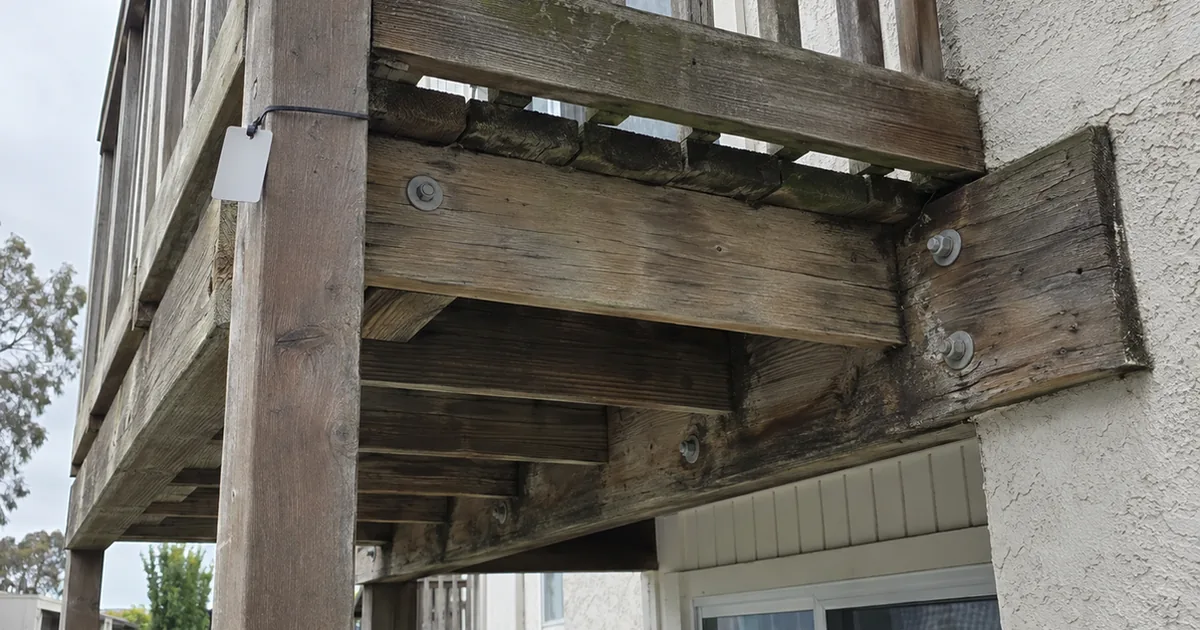
An exterior elevated element is a load-bearing component together with its associated waterproofing system. It extends beyond the exterior walls of the building. It is on a deck, balcony or stairway more than six feet above ground level. And it is supported in whole or in large part by wood or wood-based products.
Take those one at a time. A balcony that sits four feet above a patio is below the height threshold. A concrete or steel framed balcony on a mid-rise is not supported in significant part by wood. An interior stairwell is not beyond the exterior walls. And the phrase “together with their associated waterproofing system” is doing more work than it looks: the waterproofing is part of the element, not a separate finish question, which is why these inspections routinely involve opening something up rather than looking at a surface.
That last point connects to why the law exists at all. Elevated wood structures fail at connections and at the waterproofing above them, and both of those are hidden. The deck ledger attachment is the single connection that decides whether a balcony stays on a building, and it is behind siding. The waterproofing assembly over a deck or balcony is under a walking surface. Neither is visible to anybody standing on the balcony.
The two clocks, and the extension most summaries missed
The original SB 721 deadline for a first inspection was January 1, 2025. Assembly Bill 2579, Chapter 835, approved by the Governor on September 28, 2024, moved it. The statute now reads that the inspection shall be completed by January 1, 2026, and by January 1 every six years after that.
AB 2579 made two related adjustments at the same time. For properties that had been inspected within three years before January 1, 2019, the grace period was likewise extended, so no new inspection was required under the section until January 1, 2026. And for buildings whose permit application was filed after January 1, 2019, the first inspection has to occur no later than six years following issuance of a certificate of occupancy by the local jurisdiction, which decouples newer buildings from the fixed calendar date entirely.
We are flagging the extension specifically because a large amount of the published guidance on this law was written in 2023 and 2024 and still names January 1, 2025. If the summary an agent is working from gives that date, it predates AB 2579 and should not be relied on for anything else either. This is the same failure mode we described in our piece on the AB 968 flipper disclosure law, where a cross-referenced dollar threshold moved and almost none of the secondary coverage followed it. Read the current code text.
The SB 326 clock is different on purpose. Civil Code 5551 requires the first inspection to be completed by January 1, 2025, and then every nine years thereafter, timed to coordinate with the association’s reserve study.
Nine years, not six. That is not a typographical difference between two versions of the same rule, it is two different legislatures making two different judgments about two different ownership structures, and the reserve study alignment is the reason for it. An association is already on a periodic cycle of assessing and funding component replacement, and the balcony inspection was written to ride along with that cycle rather than to run on its own calendar.
The practical consequence for a condo transaction is that the association’s inspection report is a reserve-adjacent document. It belongs with the reserve study, the budget and the minutes in the package a buyer reviews, and its findings frequently point at future special assessments.
Who is allowed to do the inspection
The two statutes draw the qualified inspector line in noticeably different places.
Under SB 721, the pool is wider: licensed architects, licensed civil or structural engineers, contractors holding an A, B or C-5 license with at least five years of experience constructing multistory wood frame buildings, and certified building inspectors or building officials from a recognized association.
Under SB 326, the pool is narrower: a licensed structural or civil engineer or architect, who must exercise the care of a reasonably competent and diligent professional. Contractors and certified building inspectors are not on that list.
If somebody hands you an association report signed by a general contractor, that is a question worth asking. It is also, in both directions, a reminder of a scope boundary we state constantly: a home inspector is not on either list, and a standard home inspection is not and cannot be substituted for an SB 721 or SB 326 inspection. What we do is a limited visual examination of the dwelling. What these statutes require is a destructive or semi-destructive structural examination by a specified licensed professional. Those are different services, and any inspector who blurs them is doing a client harm.
Sampling: fifteen percent versus a statistical sample
Here is the difference that gets flattened most often in secondary coverage, and it changes what a report means.
SB 721 sets a minimum. The inspector examines at least fifteen percent of each type of exterior elevated element, and the examination includes exploratory openings rather than being purely visual. Fifteen percent of each type is the floor, and “each type” matters: cantilevered balconies, walkways and exterior stairs are separate types and each gets its own fifteen percent.
SB 326 sets a statistical standard instead. The sample has to be large enough to provide 95 percent confidence that the results reflect the whole, with a margin of error no greater than plus or minus five percent. On a small association that can mean inspecting nearly everything. On a large one it can mean a smaller proportion than fifteen percent. It is a different instrument aimed at a different question.
Neither one is an inspection of your particular balcony. A buyer reading an association report that found no immediate threat should understand that their unit may not have been in the sample at all.
What has to happen after a bad finding
Under SB 721 the timeline is specific and the meter runs. The report goes to the owner within 45 days of completion. If the inspector identifies a condition posing an immediate threat to the safety of occupants, that gets communicated within 15 days, and the owner has to act immediately: preventing occupant access to the element until repairs are made, and making emergency repairs without waiting on the ordinary process.
For non-emergency findings the owner applies for a permit within 120 days and completes the repair within 120 days of permit approval. Local enforcement agencies may assess civil penalties in a range of one hundred to five hundred dollars per day after a thirty day notice period where repairs have not been completed, with a 180 day compliance window before penalties attach. There is also a specific carve-out where asbestos-containing material is discovered: a nine month abatement period plus three additional months to complete the inspection.
Records have to be maintained for not less than two inspection cycles, and they are disclosed at the sale of the property.
Why the disclosure piece is the part agents should care about
That last sentence is the one to carry into a listing appointment.
For a rental building under SB 721, the report is a retained record that follows the property to a sale. For a condominium under SB 326, the report sits in the association’s documents, which a buyer receives as a matter of course. Either way, a buyer in a transaction on a covered building is going to see a document that says, in a professional’s words, what condition the elevated wood structures are in and what work they need.
An agent who reads that document before it lands in a buyer’s hands is in a much better position than one who reads it afterward. Specifically, look for whether any element was identified as an immediate threat, whether the repair timeline described in the report has actually been met, and whether the recommended work reads like maintenance or like a capital project. On an association property, unfunded elevated element repairs are one of the more reliable predictors of a special assessment, and that is a number a buyer will feel.
What a home inspection does and does not add here
We inspect the dwelling. On a condominium that generally means the unit and the systems serving it, which is a narrower scope than a house and one that surprises buyers who have not bought a condo before. On a small apartment building bought as an investment, it means the building as a dwelling, still without the destructive testing an SB 721 inspection requires.
What we can add is condition context that the statutory report does not cover, and honest reading of the report that does exist. We will tell a buyer when the waterproofing on a walking surface looks like it is at the end of its life, when a guardrail attachment or its geometry looks wrong, when water staining below a balcony suggests the assembly above it has been leaking for a while, and when a repair looks recent enough that we would want to see the permit. What we will not do is certify compliance with either statute or write anything that could be mistaken for that. Our report says what we saw and what we could not see, and our inspection report format is built to make that distinction visible rather than buried.
For anything genuinely structural on an elevated element, the answer is a licensed structural or civil engineer, and we will say so in writing rather than stretching our own scope.
Quick answers
Does this apply to a single-family house? No. Both statutes require three or more multifamily dwelling units. A house, a duplex and a detached condominium are all outside them.
My client’s balcony is concrete. Is it covered? Probably not. The Civil Code definition requires the element to be supported in whole or in large part by wood or wood-based products. Confirm the framing before assuming either way.
The building is four feet off the ground. Covered? The definition sets the threshold at more than six feet above ground level.
The seller says the inspection was done in 2019. Is that still good? Under SB 721 the cycle is six years, so a 2019 inspection is outside the current window. Under SB 326 the cycle is nine years. Check which statute the building falls under before answering.
Can you do the inspection for us? No. We are not on either statute’s list of qualified inspectors, and we will not present a home inspection as satisfying either law. We are happy to read the existing report with you and to inspect the dwelling itself. Our frequently asked questions cover where our scope starts and stops.
The honest summary
Two laws, two building types, two clocks, two inspector pools, two sampling standards. SB 721 covers rental buildings of three or more units, first inspection due January 1, 2026 after the AB 2579 extension, then every six years, minimum fifteen percent of each element type with exploratory openings, wider inspector pool, specific repair timelines and daily civil penalties. SB 326 covers associations, first inspection due January 1, 2025, then every nine years aligned to the reserve study, a statistically significant sample at 95 percent confidence, engineers and architects only.
Both deadlines are behind us. That means the question in a 2026 transaction is no longer whether the owner is going to comply, it is whether they did, and what the report said.
If you are working a condo or small multifamily deal and want a second set of eyes on the building itself, book an inspection or call 1-888-88-INSP-9. For what a standard inspection covers, see what’s included. We work across California, including San Rafael, Larkspur, Belvedere and Oakland.
Related reading
- Deck Ledger Attachment covers the single connection that holds an elevated structure to a building.
- Deck and Balcony Waterproofing covers the assembly over a walking surface and how it fails.
- California’s Flipper Disclosure Law: AB 968 covers another statute whose published summaries went stale.
- How to Read a Home Inspection Report in California covers how to prioritize what a report actually says.