A dry inspection cannot show how water behaves
On inspections right after the first real storm of the season, we learn things a dry-season visit cannot show. Rain turns “might be a problem” into “water is moving here.”
A dry inspection can show stains, cracked sealant, rust, soil erosion, or a downspout that ends too close to the house. It cannot show whether water actually runs toward the foundation, backs up at a corner, or enters through a window head during a storm.
We report visible conditions. We do not schedule storms.
If the inspection happens during rain, we watch where the water goes and document what is visible. If the inspection happens on a clear day, we look for evidence of past moisture and explain what remains unproven. That distinction matters to homeowners, sellers, agents, and buyers.
Our related guide on winter and dry-season inspections in California covers the timing issue in more detail. The short version is simple. Dry weather limits the evidence.
Rain reveals the water paths a dry day hides
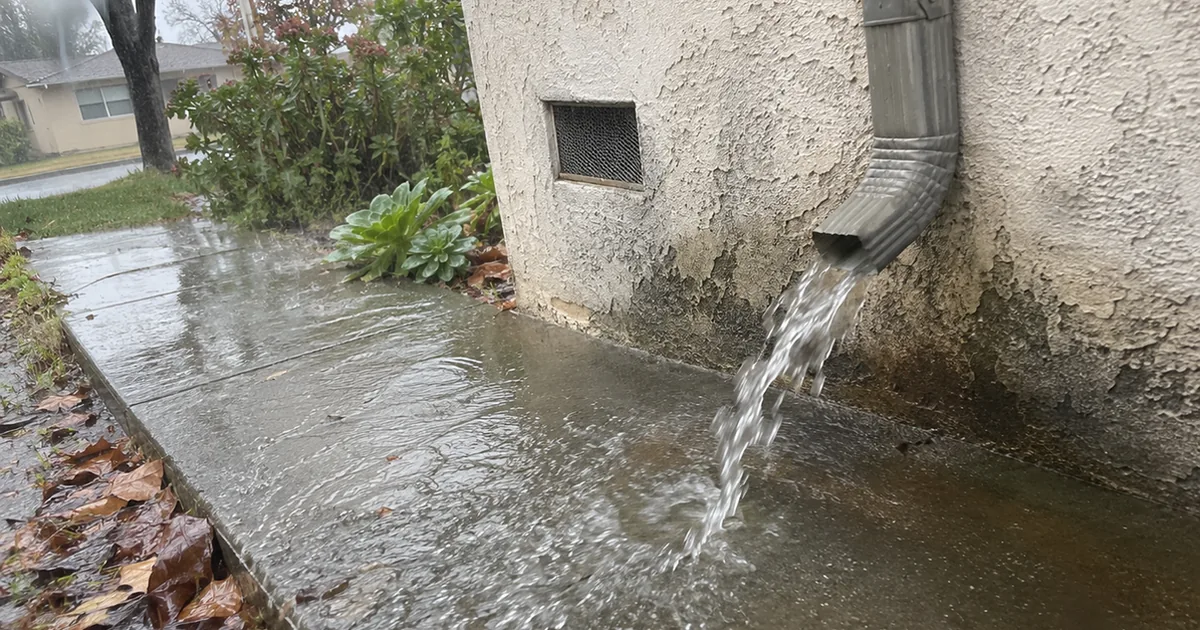
Rain can show the downspout discharge point, water sheeting across a walkway, pooling at a slab edge, or splash-back marking stucco and siding.
We look first at the outside of the house. Water may run away from one wall and toward another. A downspout may discharge beside the foundation. A patio may slope toward the building. A low area may hold water against a slab edge even when the soil looked firm and dry the day before.
Inside, a ceiling or wall stain that turns damp during rain is evidence of active water at that time. A dry stain is history. It does not prove the leak is still active, and it does not prove the leak is gone.
An attic inspection may show active dripping at the sheathing, damp insulation, or a wet area below a roof penetration. A window head or door threshold may show fresh water entry. A crawl space may have damp soil, standing water, or an entry point where runoff is reaching the foundation.
We may use a moisture meter or FLIR infrared camera scan as support. Neither one proves the source of a leak by itself. A cool area can have several causes. A meter reading can change with materials and conditions. We use those tools to guide inspection and documentation, not to replace judgment. Our guide on reading a thermal image during a home inspection explains that distinction.
California gives us a six-inch yardstick
For new work, California Residential Code R401.3 says lots are to be graded so surface water drains away from foundation walls. The grade is to fall not fewer than 6 inches within the first 10 feet.
That is a useful yardstick when we are watching rain move across a property. It is not a magic test that settles every older-house question.
The same rule addresses sites where lot lines, walls, slopes, or barriers prevent that fall. In those conditions, drains or swales must carry water away from the structure. Impervious surfaces within 10 feet of the foundation are to slope not less than 2 percent away from the building. Surface drainage is to reach a storm sewer conveyance or another approved collection point without creating a hazard.
We may use a string and level, or we may simply watch the water. The point is not to turn a home inspection into a grading survey. The point is to identify what the water is doing.
A patio or walkway that slopes toward the house deserves attention. So does a slab edge where water remains after the surrounding surface has drained. We report the observed condition and recommend the right follow-up when the visual evidence points to a drainage problem.
An older house was built under whatever code applied at that time. A house that predates the current rule is not automatically violating R401.3. The 6-inch-in-10-feet figure remains a practical reference for understanding where water is likely to go.
Our grading and drainage guide for agents covers the same issue in a property-specific way.
Gutters show their failures during the storm
Gutter problems become obvious when water is moving through the system.
We look for overflow at corners, inside corners, and low sections. We watch for water spilling over the front edge and running down the wall. We look for downspouts dumping beside the foundation instead of carrying water away. Splash-back may leave fresh marks on stucco or siding.
Tree debris can block a gutter or downspout opening. A system may look clean from the ground and still overflow at a joint or corner once the water volume rises.
Under the InterNACHI Residential Standards of Practice, the inspector inspects gutters and downspouts from ground level or the eaves. The inspector is not required to inspect underground downspout diverter pipes. A pipe disappearing below grade does not prove that it is open, connected, or discharging at a safe location.
That is why we describe what we can see. We do not report an underground pipe as working because its upper end looks intact.
The roof drainage and gutter guide goes deeper on gutters and roof drainage for one Los Angeles neighborhood.
A wet roof is not a reason to walk on it
Inspectors are not required to walk any roof surface. Wet roofing can be unsafe, and we decline a roof walk when the condition creates that problem. The report should state that the roof area was not inspected and give the reason.
There is no explicit InterNACHI rule saying an inspection cannot happen in rain. The standards do require the inspector to avoid unsafe acts. They also require reporting observed indications of active roof leaks.
During rain, we may inspect from the ground or eaves. We may inspect the attic side where access is available and safe. We may use drone roof imagery for a roof that is unsafe or inaccessible to walk. That gives us another view of roof-covering materials and drainage components, but it does not turn a visual inspection into a roof performance test.
The drone roof inspection guide explains what imagery can show. The attic hatch guide explains why access to the attic side matters.
ASHI also requires inspection of roof drainage systems and conditions such as grading, surface drainage, vegetation, and retaining walls when they are likely to affect the building. It does not require dangerous procedures, geological or soil inspection, or erosion-control inspection. If a designated system is present but not inspected, the report lists it and gives the reason.
The finding tells you what happens next
Rain-day findings do not all call for the same response. The visible condition, its location, and the limits of the inspection matter.
| Finding seen in rain | What it likely means | What we report | Sensible next step |
|---|---|---|---|
| Downspout discharging beside the foundation | Roof water is reaching the base of the building | Visible discharge location and any splash-back or pooling | Extend or redirect the discharge, then re-check during another rain |
| Pooling against a slab with grade sloping toward the house | Surface water is being directed toward the structure | Observed water and grade condition | Ask a qualified drainage or grading contractor to evaluate before close of escrow |
| Active drip at attic sheathing | Water is entering through the roof system or a roof penetration | Active leak indication and the area observed | Obtain a roofer evaluation, rather than relying on a dry-day re-look |
| Damp crawl space soil or entry point | Water is reaching the crawl space or its perimeter | Observed moisture, location, and access limits | Use the crawl space inspection guide and obtain specialist advice when needed |
| Gutter overflow at a corner | The visible drainage system is not carrying water at that location | Overflow, debris, damaged section, or discharge condition | Correct the visible issue and observe the system during rain again |
A downspout discharge location may be a straightforward correction. That does not mean every drainage condition is simple. Pooling against a slab, active attic water, or a damp crawl space may require a qualified contractor with a different scope.
For repair documentation, our guide on verifying repairs before close of escrow explains why a written claim that something was fixed is not the same as seeing the result.
Document the water, not the argument
Rain-day documentation should show where water goes.
Take dated photos or video of the discharge point, the pooling area, the wet wall, or the attic drip. Photograph the same location from two angles. Record how long it had been raining when the condition was observed. Keep the wording factual.
“Water flowing from the downspout toward the foundation” is useful. “Bad drainage” is a conclusion that leaves out the evidence.
For sellers, this record shows what was visible at the time of inspection and what was not. For buyers, it preserves the condition for follow-up. Agents can attach the photos or report language to the disclosure conversation. Questions about disclosure duties belong with the agent or attorney.
A same-day written report helps keep the timing clear. Matterport 3D tours with tagged findings can also help people understand where a condition is located, especially when several parties are reviewing the property.
The guide to reading a California home inspection report covers how findings, limitations, and recommendations fit together.
One storm cannot prove every drainage question
Rain gives us a real data point. It does not give us every data point.
A clear, dry attic during a light drizzle proves less than the same attic after hours of steady rain. A dry crawl space on one inspection day does not prove that subsurface water never enters. A roof can stay dry through one storm and leak in the next, because wind-driven rain reaches different spots than a straight downpour.
InterNACHI does not require the inspector to inspect geological, geotechnical, hydrological, or soil conditions. It also does not require inspection of erosion-control measures, drainfields, or dry wells. ASHI likewise excludes geological and soil conditions and erosion-control inspection from its required scope.
Seal failures, hidden subsurface drainage, and soil behavior may need a specialist. A roofer is the right call for an active roof leak. A drainage or grading contractor is the right call for persistent pooling or water directed toward the structure, and our subsurface drainage guide shows what that kind of work involves. A geotechnical professional may be appropriate when the question concerns soil or site conditions.
See what a home inspection covers and what needs a specialist and what “not inspected” means in a report before treating an inspection report as a guarantee about hidden conditions.
A dry-day inspection still has useful evidence
When the inspection is dry, we look for the history rain leaves behind.
That includes staining patterns, efflorescence, rust at fasteners, soil erosion channels, splash marks, and the condition of downspout extensions. We look at the bottom of stucco for signs that the drainage path may be blocked. Our stucco weep screed guide explains why that lower edge matters.
We may see a roof edge or downspout condition that can be observed safely. Inspectors are not required to perform water tests. At our discretion, and only where safe and with owner consent, we may sometimes run a hose at a roof edge or downspout. That is a limited observation, not a storm simulation.
A dry-day report should say what was seen and what was not tested. It should not turn a clean-looking surface into proof that water will behave properly in the next storm.
Quick answers about rain-day inspections
Can you inspect in the rain?
Yes, where conditions are safe and the inspection scope remains possible. We report visible water conditions and identify areas that cannot be inspected.
Should you reschedule because it is raining?
Not automatically. Rain may provide useful evidence. A roof walk or another activity may still be declined when it is unsafe.
Will a rain-day inspection cost more?
This article does not quote prices. Ask when scheduling.
Do you walk the roof in rain?
No roof walk is required, and a wet roof may be unsafe. We report the area as not inspected with the reason and use safe alternatives where available.
What should a seller do before a forecast storm?
Clear gutters. Extend downspouts. Clear the stucco weep screed at the bottom of the wall. Keep the attic hatch accessible.
The honest summary
Rain shows what a dry visit cannot. It does not remove the need for judgment, documentation, or specialist follow-up. The practical change is simple: record where the water goes, separate active evidence from old staining, and treat every “not inspected” line as a real limit on what the report can prove.
To see what Inspection.re includes, review what is included in an inspection, the inspection FAQ, and a sample inspection report page. We inspect homes in Tarzana, Lake Balboa, Lemon Grove, Oakland, and San Francisco. For scheduling, contact Inspection.re at 1-888-88-INSP-9.