Three buttons answer three different electrical questions
On inspections, the little TEST button is one of the first things we press, and it is also the thing people trust too much.
There are three separate tests in play:
- The GFCI device’s own TEST button.
- A plug-in receptacle tester’s GFCI button.
- The TEST button on an AFCI breaker.
Each one answers a narrow question. A pass means the trip mechanism responded during that test. It does not prove the circuit is wired correctly. It does not prove every outlet that should be protected is protected. It does not prove the device will work next month.
We inspect visible electrical components and report what the test actually showed. That distinction matters when you are reading a report, reviewing a repair, or deciding whether an electrician needs to look closer.
The GFCI’s own button proves the trip mechanism worked now
A GFCI’s own TEST button should interrupt power when the device is working properly. That is the direct test of the device’s trip function.
The Consumer Product Safety Commission recommends testing GFCIs monthly to assure continued protection. Leviton gives the same monthly advice. CPSC also says infrequently used and portable or cord-connected GFCIs should be tested before each day’s use.
The simple procedure uses a nightlight:
- Plug the nightlight into the outlet and turn it on.
- Press TEST.
- The light should go out.
- Press RESET.
- The light should come back on.
A click is not enough. CPSC’s own staff have noted that people often assume the click means the test worked without confirming that power actually shut off. We want to see the result, not just hear the mechanism.
If the light stays on after TEST, the GFCI should be replaced or inspected by an electrician. If the light does not come back on after RESET, CPSC says to replace the GFCI. CPSC also says to wear shoes while testing, especially outdoors or on wet ground.
A pass tells us the GFCI tripped and restored power during that test. It does not clear the wiring, the grounding, the upstream protection, or other outlets on the circuit.
A plug-in tester asks about accessible wiring and ground
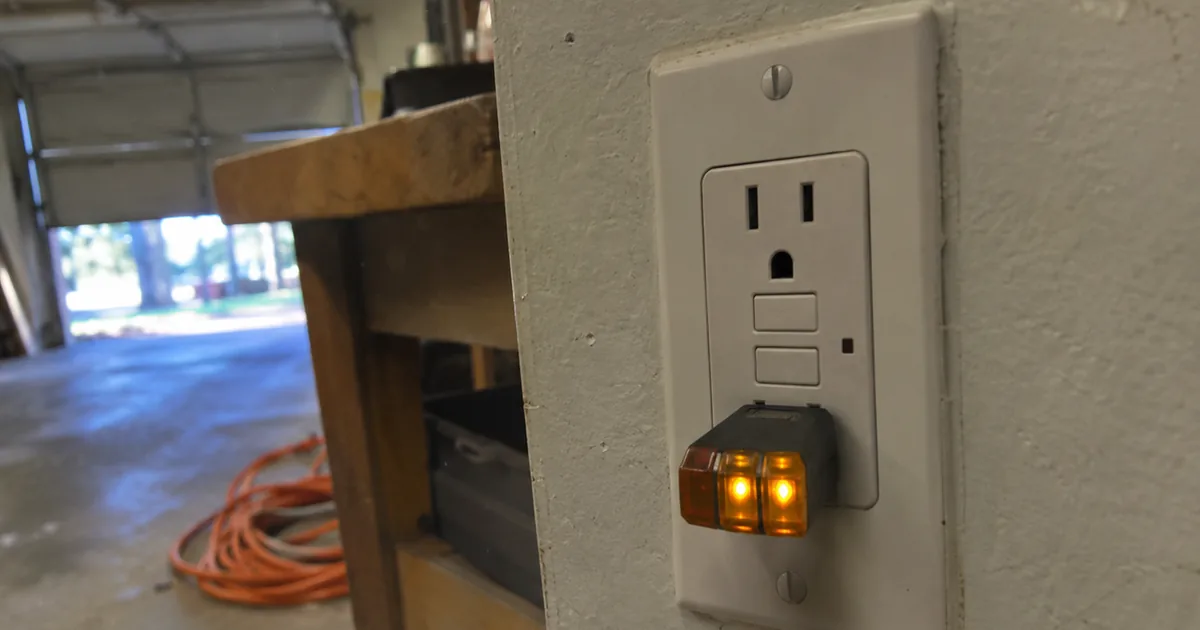
A plug-in receptacle tester does a different job. Its indicator lights are used to check accessible wiring conditions, including ground. Its GFCI button attempts to trip the protective device serving that receptacle.
Those are useful observations. They are not the same as pressing the GFCI’s own TEST button.
In our experience and in what inspectors widely report, an open ground can cause a plug-in tester’s GFCI button to fail to trip a GFCI that works properly when its own TEST button is pressed. The device can trip from its own button while the plug-in tester reports a different result.
That disagreement needs to be reported honestly. We do not call a working GFCI defective based on the tester button alone. We also do not call the installation fine just because the device’s button trips. The ground needs to be checked by an electrician.
The tester’s lights can show conditions such as open ground, reverse polarity, or open neutral. Results vary by brand, and the lights do not test arc-fault protection. A tester can provide a useful clue about accessible wiring. It cannot replace the device’s own test button, and it cannot answer every question about the circuit.
A downstream outlet may have no TEST or RESET buttons of its own. It may be protected by a GFCI device upstream. In that situation, we look for the upstream device and use the available testing methods where possible.
Our Redlands AFCI and GFCI guide goes deeper into how protection can be distributed through a home.
An AFCI is tested at the breaker, not with a pocket tester
An AFCI breaker has its own TEST button. With the panel energized and the breaker on, pressing that button should move the handle to the tripped position.
The InterNACHI Standards of Practice says the inspector shall inspect receptacles observed and deemed to be AFCI-protected using the AFCI test button, where possible. That wording matters. The breaker’s own button is the named method.
Plug-in testers are widely reported as unreliable at tripping AFCI breakers. Some indicator devices may trip some AFCI breakers, but results vary by brand. The AFCI breaker’s own button is the method we rely on for the AFCI trip test.
Read the instruction sheet on the breaker or the panel door for the exact procedure for that brand. The handle position and reset procedure can vary. If the button does not trip the breaker, or if the breaker will not reset after a proper test, the report should direct the issue to an electrician.
We say “where possible” because an inspector may not be able to identify the protective device with confidence, reach the relevant control safely, or operate it without creating a problem in an occupied home.
“Observed and deemed” limits what an inspection can test
The Standards of Practice uses the words “observed and deemed.” The inspector tests devices that are visible and that can reasonably be identified as GFCI or AFCI protected.
A GFCI breaker in the panel can protect outlets that look ordinary. A GFCI receptacle can protect other outlets downstream. A panel directory may be blank or wrong. A device may look like a GFCI without actually protecting the locations someone assumes it protects.
The same issue applies to AFCI protection. A panel label can help, but a label is not proof by itself. We inspect what we can see, identify what we can identify, and describe the limits in the report.
InterNACHI’s electrical standards call for GFCI devices and breakers to be tested using a GFCI tester, where possible. They call for AFCI protection to be tested using the AFCI test button, where possible. The standards do not turn every ordinary-looking outlet into a confirmed protected location.
This is why a report may mention a tested GFCI receptacle without claiming that every outlet on the circuit has been verified. The report should tell you which device was observed, what test was used, and what result was seen.
A passing button does not prove complete protection
A passing test is a snapshot.
It does not prove every location that should be protected has protection. It does not prove the wiring is correct. It does not prove the device will trip next month. It does not prove the panel directory is accurate.
A GFCI that no longer trips can still deliver power. The outlet may operate a lamp, charger, or appliance normally while providing no functioning ground-fault protection. An outlet that works tells you nothing about whether the protective function works.
A clean thermal image also does not clear a circuit. FLIR infrared imaging can show a warm receptacle or breaker under load. A clean image does not prove the device will trip, does not prove the grounding is correct, and does not prove every location is protected. See how to read a thermal image in a home inspection for that distinction.
The same principle applies to a replacement outlet, a new cover plate, or a panel label. Appearance is not a functional test. The same is true when a plug-in appliance is the suspect: our piece on a recalled space heater and the outlet behind it shows why we look at the receptacle and cord separately from the product. A recalled panel or breaker is a different question again, one that a test button cannot answer.
Occupied homes can make a test the wrong move
Tripping an AFCI or GFCI breaker can cut power to something that matters. The circuit may serve a refrigerator, medical equipment, clocks, computers, or a sump pump.
In an occupied home, we may ask first before tripping a breaker. We may leave a device untested if the risk of cutting power is not clear. When we do, we write down what we skipped and why.
The InterNACHI standards do not require the inspector to operate or reset over-current protection devices or overload devices. They do not require the inspector to activate electrical systems or branch circuits that are not energized. They also do not require the inspector to operate or test smoke or carbon monoxide detectors or alarms.
That is not a blank check to ignore an electrical concern. It is a boundary around what can be operated safely and reasonably during the inspection. The report matters because it records the device, the test, the result, and any limitation.
Our guide to reading an inspection report explains how to separate a tested item from an item that was inaccessible, not energized, or left untested for a stated reason. We also cover areas an inspection could not reach in a separate guide, and the same limits apply to a garage circuit feeding an EV charger.
Older California homes may lack protection required in newer construction
A missing GFCI or AFCI is not automatically proof that an older California home violates the code that applied when it was built.
The 2025 California Electrical Code is based on the 2023 National Electrical Code and took effect January 1, 2026. Which locations required GFCI or AFCI protection depends on the year the home was built and the code edition in force at the time. The locations listed by code have grown over the years.
The newer code applies to new permits. It does not automatically apply retroactively to every older house. A missing GFCI in an old kitchen may be a safety upgrade conversation rather than a violation claim.
We are not giving legal advice through an inspection report. We are identifying conditions and directing questions to the right professional. The written notice California sellers give that a professional electrical inspection may be advisable is covered in our SB 382 article.
The home’s age changes the code question. It does not change the safety question. A device that fails its own test still needs attention.
The next step depends on which result you got
If the GFCI trips from its own TEST button, the nightlight goes out, and RESET restores power, record the result and continue reviewing the rest of the report. The device passed that test at that moment.
If the GFCI will not trip, replace it or have an electrician inspect it. If it trips but will not reset, have an electrician inspect it.
If the plug-in tester shows open ground, reverse polarity, or open neutral, address that wiring condition before treating the receptacle as cleared. If the tester’s GFCI button and the device’s own button disagree, describe both results and have an electrician evaluate the ground and protection.
If the AFCI breaker does not trip from its own TEST button, or will not reset after the test, use the breaker instructions and refer the issue to an electrician.
Use a licensed electrician for repairs and for questions about circuit protection beyond what the inspection can establish. Our guide to which contractor license applies to an electrical referral in California explains the referral boundary.
After repairs, verify the work before the deadline that matters to you. We cover that process in how to verify repairs before close of escrow. A contractor’s invoice is not the same thing as a confirmed repair.
Five questions people ask after the test
How often should I test a GFCI?
Test it monthly. CPSC says infrequently used and portable or cord-connected GFCIs should be tested before each day’s use. Wear shoes while testing, especially outdoors or on wet ground.
Can I use only a plug-in tester?
No. A plug-in tester checks accessible wiring and ground and has its own GFCI button. Use the GFCI device’s own TEST button for the device’s trip function. A plug-in tester does not test arc-fault protection.
Why did the inspector not test an outlet?
The device may not have been energized, may not have been identifiable as protected, may have been inaccessible, or testing it may have risked cutting power to equipment in an occupied home. The report should state the limitation.
Does a GFCI outlet protect other outlets?
It can. A GFCI receptacle may protect downstream outlets that do not have TEST and RESET buttons. A GFCI breaker may protect outlets that look ordinary. Do not assume the protection path from appearance alone.
Does a thermal image replace the test button?
No. A thermal image can show a warm receptacle or breaker under load. It does not test the trip mechanism, grounding, correct wiring, or complete circuit protection.
The same “what a pass or a clear result actually proves” question applies to glass: see why a clear window can still have a failed seal.
Use the report to decide what gets checked next
We provide same-day reports, photos, and InterNACHI-certified inspectors for service in Redlands, Temecula, Riverside, San Diego, and Los Angeles.
Read the report for the exact device tested and the exact result. Check whether the issue is a failed trip test, a wiring indication, an unidentified protection path, or a device that could not be tested. See what an inspection includes before scheduling, look at a sample inspection report to see how results are shown, and use the FAQ when the terminology is unclear.
If an outlet works but the GFCI does not trip, treat that as a failed protective function. If a tester and a device disagree, report both results and call an electrician. If protection is missing in an older home, ask whether an upgrade is appropriate under current conditions instead of assuming the house violates the newer code.
That is what you should do differently: stop treating one click as a complete electrical answer, identify which test produced the result, and match the next step to that result.
For an inspection question, call 1-888-88-INSP-9.
The outlet test question is one stop on our room-by-room inspection-day checklist.